किमस्थिमालां किमु कौस्तुभं वा
परिष्क्रियायां बहुमन्यसे त्वम् ।
किं कालकूटः किमु वा यशोदा-
स्तन्यं तव स्वादु वद प्रभो मे ॥
Author:Shatavadhani Dr. R. Ganesh
After a very well spent morning at Sanchi and being fully satisfied, we drove to Vidisha. Lunch was foremost on the agenda. After enquiring with locals, we were directed to a ‘Jain bhojanalay’, a nondescript, unassuming luncheonette on the first floor of a dirty drab building close to the railway station. We had made our way there through the not-so-healthy ‘Hospital road’. But the food was a refreshing contrast. The ambience was forgotten in the taste and aroma of the food.
A rare interview of Dr S. Srikantha Shastri, a historian par excellence. His magnum opus "Bharatiya Samskruti", a monograph in Kannada, is a must-read for all serious students of Indian culture.
As a remarkable patriot, thinker, and visionary, Sri Aurobindo’s contributions to India are priceless. Unlike other patriots and leaders of his generation, it was in spite of his upbringing that Sri Aurobindo turned out to be such a devoted son to Mother India.
Enamored by the British, Aurobindo’s father Dr. Krishna Dhun Ghose did everything within his power to make his children grow up to be Englishmen. His dream was for his children to enter the Indian Civil Service and so the entire family moved to England in 1879, when Aurobindo was just 7.
स्मरगरलखण्डनं मम शिरसि मंडनं
देहि पदपल्लवमुदारम् ।
ज्वलति मयि दारुणो मदनकदनारुणो
हरतु तदुपाहितविकारम् ॥
In their years of exile, the Pandavas lived in the picturesque Dvaitavana abounding in beautiful trees and delicious fruits. One day, a deer carried away – between its antlers – the fire-producing sticks of a poor priest who was performing an important yajña. The priest came to the Pandavas seeking help. The five brothers took up their arms and went looking for the deer. Even after exhausting all their knowledge in hunting and combat, they were unable to catch the deer.
A short documentary of Kuppalli Venkatappa Puttappa, the inimitable poet. He is popularly known as 'kuvempu'. His epic-poem Ramayana Darshanam was awarded the Jnaanapeeth award.
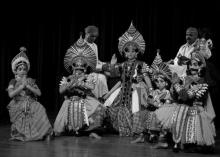
Let us look at Yakshagana and its allied art-forms from the point of view of angikaabhinaya (communication through the body and gesture language). Kuchupudi and Bhagavatamela are rich in angikaabhinaya. However, in recent times, Kuchupudi has been relinquishing its theatrical format, i.e., the format of Yakshagana and Kalaapa, and is heading towards becoming a dance (nrtya) format.
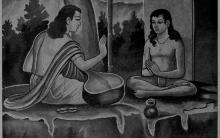
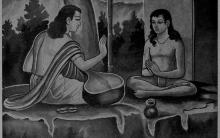
In the Vana Parva (Book 3) of the Mahabharata, during the course of Yudhistira’s discussion with sage Markandeya, the latter narrates the story of Kaushika and Dharmavyadha. It is a wonderful episode of how a learned ascetic obtains life-lessons from an unlettered butcher in Mithila.
Following a series of incidents, Kaushika lands up at the shop of Dharmavyadha, who is busy selling deer and buffalo meat. Seeing the ascetic, Dharmavyadha rises from his seat and walks up to him. “Welcome, O holy one! Come, let us go to my house.”
एतद्बभ्रुकचानुकारिकिरणं राजद्रुहोऽह्नः शिर-
श्छेदाभं वियतः प्रतीचिनिपतत्यब्धौ रवेर्मण्डलम् ।
एषापि द्युरमा प्रियानुगमनं प्रोद्दामकाष्ठोत्थिते
सन्ध्याग्नौ विरचय्य तारकमिषाज्जातास्थिशेषस्थितिः ॥