
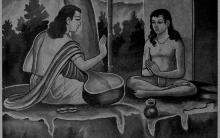
The divine sage Narada is credited with the composition of eighty-four sutras (aphorisms) on bhakti (devotion). In this four-part series, I provide simple English translations of the sutras. I will first present the original in Devanagari and then the translation.
Author:hari
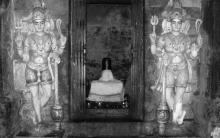
Nilakantha Dikshita is one among the fine Sanskrit poets in whom we find a happy blend of erudition and creativity. He lived during a time when natural expression of the language was chained to a heavy boulder of exhibitionism, and originality suffered under its weight. Only a few poets could use this to their advantage. Kshemendra, Bhallata and Venkatadhvari barely managed to liberate themselves from this fetter and let their words flower freely. But this freedom too, was limited in their case.
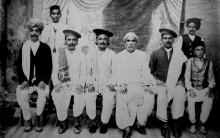
Kosambi hurls an accusation at Krishna for being the creator of the system of varnas –
“Not only that, the god himself had created such differences (G.4.13): “The four-caste (class) division has been created by Me”; this is proclaimed in the list of great achievements. The doctrines are certainly not timeless.” (Emphasis is mine)
(M&R, p.19)
While doing so, it is strange that Kosambi fails to quote the other half of the verse. The original verse, BG 4.13, says –
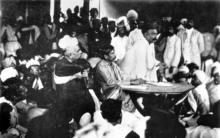
The Indian Councils Act of 1909 (popularly known as the Morley-Minto reforms) gave the Muslims of India a separate electorate. This was a strategy of the British to create a further rift between the Hindus and Muslims, which had already begun in 1905 when Bengal was partitioned on religious lines. Sharply criticizing this development, Aurobindo wrote (emphasis mine):
Apart from writing independent works like the Outlines of Indian Philosophy and Essentials of Indian Philosophy, Hiriyanna edited several difficult Sanskrit books on Vedanta and made them easily accessible to readers by providing explanatory notes. Three such notable works include (1) Vedantasaara[i] (2) Naishkarmya Siddhi[ii] (3) Ishtasiddhi[iii].
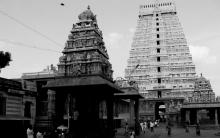
Ramana Maharshi (30 December 1879 – 14 April 1950) was an Indian sage. Born Venkataraman Iyer, he left home in 1896 at the age of 16 and landed at Thiruvannamalai. After years of deep tapas, he attained a state of jivanmukti (release from the bindings of the cycle of karma even when alive). An open-minded yet devout person, Ramana primarily focused on Self-inquiry as a means to exhaust ignorance and become one with the atman. Although he mostly remained silent, on occasion, he had discussions with visitors and disciples.
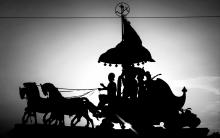
किमस्थिमालां किमु कौस्तुभं वा
परिष्क्रियायां बहुमन्यसे त्वम् ।
किं कालकूटः किमु वा यशोदा-
स्तन्यं तव स्वादु वद प्रभो मे ॥
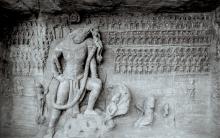
After a very well spent morning at Sanchi and being fully satisfied, we drove to Vidisha. Lunch was foremost on the agenda. After enquiring with locals, we were directed to a ‘Jain bhojanalay’, a nondescript, unassuming luncheonette on the first floor of a dirty drab building close to the railway station. We had made our way there through the not-so-healthy ‘Hospital road’. But the food was a refreshing contrast. The ambience was forgotten in the taste and aroma of the food.

A rare interview of Dr S. Srikantha Shastri, a historian par excellence. His magnum opus "Bharatiya Samskruti", a monograph in Kannada, is a must-read for all serious students of Indian culture.

As a remarkable patriot, thinker, and visionary, Sri Aurobindo’s contributions to India are priceless. Unlike other patriots and leaders of his generation, it was in spite of his upbringing that Sri Aurobindo turned out to be such a devoted son to Mother India.
Enamored by the British, Aurobindo’s father Dr. Krishna Dhun Ghose did everything within his power to make his children grow up to be Englishmen. His dream was for his children to enter the Indian Civil Service and so the entire family moved to England in 1879, when Aurobindo was just 7.