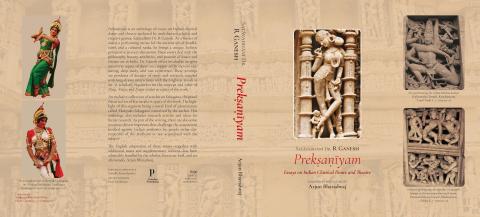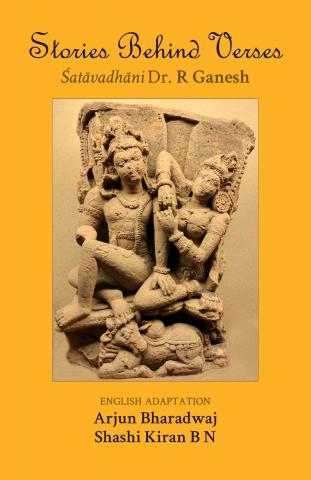
[It is a matter of immense joy and pride to us at Prekshaa Pratishtana that the prestigious Padma Bhushan Award has been conferred on our advisor and chief contributor, Shatavadhani Dr. R Ganesh. Prekshaa has been fortunate to receive his guidance right from its inception. He has been extremely generous with his knowledge and wisdom, time and resources, each of which is invaluable to us.
Ganesh is an ardent advocate of Vedanta, according to which names and forms are mere attributes. Awards mean little from this standpoint. Regardless, awards turn meaningful and bolster our faith in the system when they are conferred on the truly deserving. We offer our heartfelt gratitude and sincere namaskara to our Guru and wish him well on this happy occasion.--Ed.]
Can artistic talent and analytical acumen go hand in hand? Can a scholar of the Sanskrit language appreciate film songs? Can a poet attuned to classical metres compose lyrics for music and dance recitals? Can a performing artist deliver discourses on an abstruse aspect of philosophy? Can a connoisseur comprehend a country’s multi-dimensional cultural heritage? Can a polymath and polyglot enjoy cooking? Can an author of scholarly treatises indulge in freewheeling banter?
Yes, with aplomb! Meet Shatavadhani Dr. R Ganesh.
* * *
Ganesh was born on 4.12.1962 in Kolar, Karnataka to R Shankaranarayana Iyer and Alamelamma. He spent a few years of his early life in Gauribidanur, a humble village (now a town) located in rustic environs. He basked in the natural warmth of village life, absorbed the native ethos and developed interest in classical arts. His parents, each in their own way, strengthened the emotional core of their son: Alamelamma instilled in him a fiery zest for life and demonstrated the virtues of kindness, justice and contentment. Shankaranarayana Iyer showed the importance of integrity, hard work and discipline by his personal example. The life-enriching stories of Ramayana and Mahabharata made a lasting impression on Ganesh. He quickly picked up six languages: Kannada, Tamil, Telugu, Sanskrit, English and Hindi – the first three at home, the next three at school. The precocious boy had a well-rounded set of interests: he used to watch Telugu pauranika movies, attend Harikatha performances, perform rituals and participate in festivals.
Ganesh’s family moved to Bangalore in the 1970s. (He has remained here ever since.) Books became his dearest friends in the city. He became a member of several circulating libraries and read a wide variety of books. He would read on the bus and during intervals in movie theatres. He would read while walking, eating, talking – whenever he could spare a second. Soon, he came to be known as the kid who had polished off all the books—not candies—in the children’s section. The habit of reading has not quite left him even now. It manifests readily during long-winded speeches and boring social gatherings!
Ganesh’s irrepressible curiosity, coupled with his hunger for knowledge, led him to learn new languages. Classical languages were his first choice. Because he was fascinated by Greek mythology and literature, he decided to read these works in the original. How he went about it is remarkable. He wrote a letter addressed to ‘Any Professor of Greek, United States of America.’ By a happy turn of fate, Prof. Edward V George of Texas Tech University chanced upon this letter and wrote back. He sent books that enabled Ganesh to learn Greek through English.
In formal education, Ganesh secured a bachelor’s degree in Mechanical Engineering and a master’s degree in Materials Science and Metallurgy (IISc) as well as Sanskrit. For a brief time, he worked at R V College of Engineering and M S Ramaiah Institute of Technology as a lecturer of Mechanical Engineering. He wrote a thesis on The Art of Avadhana in Kannada and secured a DLitt. for it (Kannada University, Hampi).
This brings us to his attainments as a performing artist.
* * *
Avadhana is a classical art form unique to India. One of its major forms is Sahitya-avadhana, which involves solving a variety of poetic challenges with verses composed extempore, without any aids like pen and paper. It tests creativity and scholarship to the extreme and exhibits the performer’s ability to multitask and think laterally. By sheer happenstance, Ganesh witnessed a Sanskrit Ashtavadhana performed by a poet from Andhra Pradesh. The performer had to answer the questions posed by eight scholars on various topics amid several constraints. While this process was unfolding, Ganesh mentally composed his own versified solutions to the challenges posed to the performer. After the programme, he showed these verses to the great grammarian N Ranganatha Sharma, who thought that they were better than those composed by the performer. That was it. Ganesh felt up to the challenge and decided to try his hand at Avadhana the next day. He did and succeeded – at the ripe age of nineteen!
The art form was extinct in Karnataka when Ganesh began performing. He revived it singlehandedly and took it to great heights. Today, Ganesh is respected as a master performer – as a Shatavadhani, which means that he can compose metrical solutions to literary questions posed by a hundred scholars. Till date, he has performed more than 1,300 Ashtavadhanas and five Shatavadhanas – primarily in Kannada, Sanskrit and Telugu. In his performances, he has composed verses in eight languages and has used over three hundred and fifty poetic metres. He has performed in all formats of the art and has introduced several novel components to it. A genre of poetry called chitra-kavya is a veritable touchstone to a poet’s mastery over language. It is linguistic acrobatics. Noted performers of Avadhana in Andhra Pradesh had held that composing such supremely constrained verses on the fly is impossible. Ganesh has proved them wrong on numerous occasions. He has composed all forms of chitra-kavya impromptu. In sum, he has set the gold standard for Avadhana performances.
In parallel with reviving this ancient art form in Karnataka, Ganesh has also rekindled interest in versification among enthusiasts of literature. He is the prime mentor at Padyapaana, a platform dedicated to popularizing classical literature and metrical poetry. He has inspired many youngsters to take up the art of Avadhana.
* * *
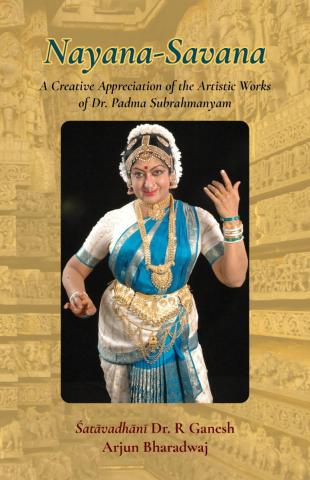
Apart from enriching literature, Ganesh has made a lasting contribution to the fields of music, dance and theatre. He has conceptualized a novel art from called Kavya-Chitra-Gita-Nrtya – a confluence of poetry, painting, music and dance. Its format is such that all these arts are performed together on a single stage. Questioners give a topic and pose aesthetic constraints to the artists, who conform to these requirements and perform impromptu. Kavya-Chitra, a subset of this art form, has found widespread acclaim. Ganesh has performed it alongside the legendary artist B K S Varma over a thousand times. The two were part of a historic world record (Limca Record) of performing Kavya-Chitra nonstop for twenty-four hours on 15.08.1997.
Ganesh has conceptualized Ekavyakti-Yakshagana, a genre of solo classical dance having its roots in Yakshagana, a traditional theatrical art form of Karnataka. He has given a sound aesthetic framework to such aspects of the art as costumes, movements, themes and music. Mantap Prabhakar Upadhya, an artist nonpareil, has performed this unique art over a thousand times.
Ganesh has similarly conceived Ekavyakti-Talamaddale, a verbal art form in which an artist puts on the role of a character and presents various episodes as soliloquies. K Diwakar Hegde, an artist imbued with unbounded creative imagination and flawless aesthetic sense, performs it regularly.
* * *
Ganesh is a much-sought-after speaker. He discourses on various topics related to Indian cultural heritage. Authentic information, comprehensive treatment of the subject and incredible insights into art and literature are distinctive features of his talks. More than 15,000 hours of his Kannada lectures are available online. These lectures have spawned an entire generation of people who are devoted to the arts, literature and Indian culture.
In addition to delivering public talks, Ganesh conducts several study circles with a small group of serious-minded people. In these sessions, he discusses a variety of texts—both ancient and modern—in detail. Raghu-vamsha of Kalidasa, The History of Dharma-shastra of P V Kane and The Story of Civilization of Will Durant are some such works.
* * *
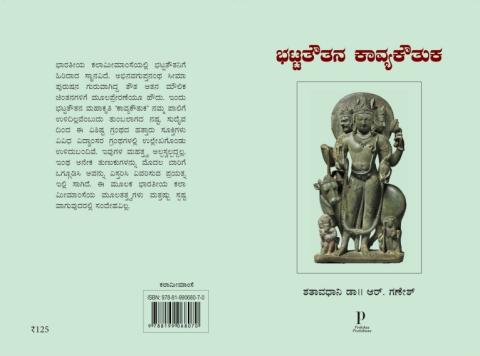
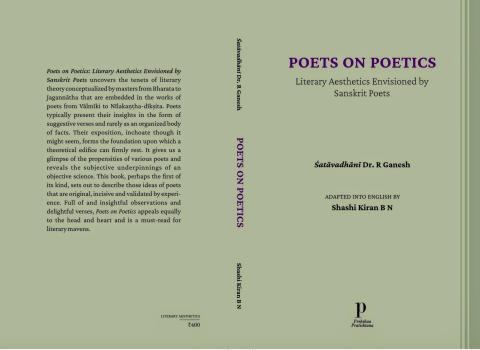
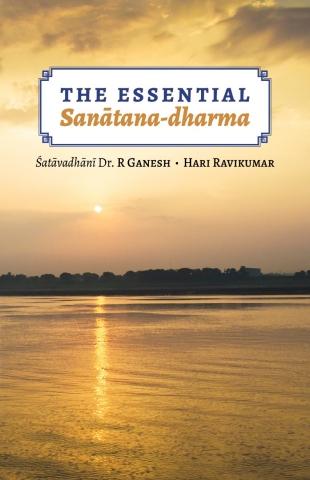
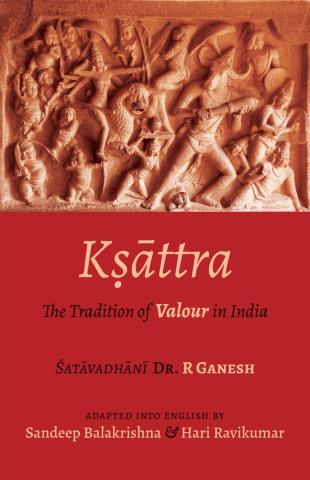
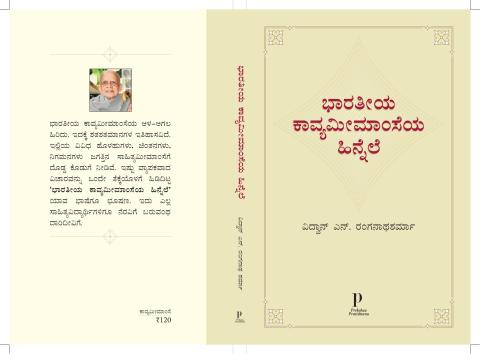
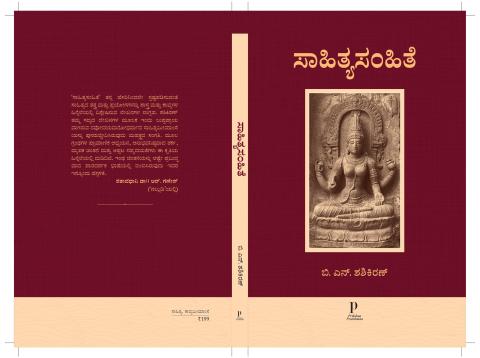
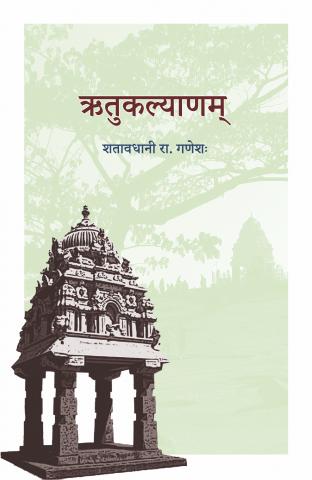
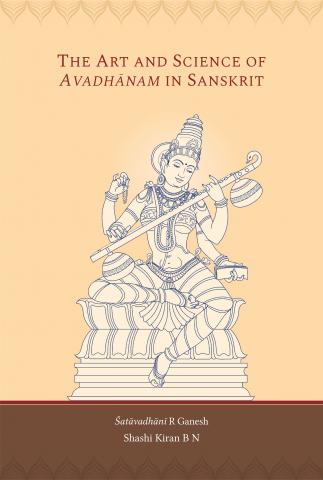
Ganesh is also a prolific author, having more than seventy books to his credit. He has written poems, plays, monographs, biographies, literary essays, analytical papers and scholarly treatises in Kannada, Sanskrit and English. He has written on various topics such as the arts, literature, aesthetics, prosody, philosophy, history, mythology and culture. The Central Sahitya Akademi has published a collection of his Sanskrit poems, titled Shatavadhani-rachana-sanchayana. He has written a Sanskrit poem based on Bengaluru, named Rtu-kalyana. Set against the backdrop of changing seasons, this work describes several facets of contemporary life in a classical style. Ganesh’s English book, The Art and Science of Avadhanam in Sanskrit (co-authored) is a definitive work on the subject. Mannina Kanasu is a profound historical novel in Kannada. Translations form a sizeable part of Ganesh’s literary output. To name just two: he has co-translated Devudu Narasimha Sastri’s Kannada classic Maha-brahmana into Sanskrit and has rendered Nori Narasimha Sastri’s Telugu classic Kavi-sarvabhaumudu into Kannada.
Through his original findings, Ganesh has contributed significantly to literary aesthetics and prosody. He has envisioned a new rasa (mood, sentiment; aesthetic experience) called dhira. Having its roots in curiosity—which is an innate human feeling—this rasa readily explains our experience in reading investigative literature such as crime chronicles, mystery novels and detective stories. Further, he has explained the correlation among the rasas, the purusharthas (goals of human life: dharma, artha, kama and moksha) and the fundamental impulses of human beings. He has expounded on the aesthetics underlying poetic metres and has decoded the appeal of various classical measures.
* * *
The body of Ganesh’s work is something a university would be proud of, something a society should be grateful for. And yet, he wears all his encyclopaedic learning lightly. Even the numerous awards conferred on him—such as the Badrayan Vyas Samman given by the President of India and the Rajyotsava Award given by the Government of Karnataka—sit lightly on his shoulders. He openly shares everything he knows with the sole intention of helping honest seekers. He likes to cut the clutter and untie age-old knots in a subject. Forget books and lectures, even the most casual of his everyday conversations are tinged with rare insights. He harmonizes erudition and creativity and shows how the old can coalesce with the new.
It suffices to say that his life is devoted to elucidating three lofty principles: brahma as the highest philosophical truth, dharma as the tenet of sustenance and rasa as aesthetic experience.
Ganesh is fiercely original and independent; yet he does not traduce tradition. He constantly looks to outdo himself; the comfort zone does not comfort him. He is as generous in appreciation as he is unsparing in criticism. His intellectual integrity stands out in this age of pervasive political correctness. Above all, he remains humble and accessible despite his staggering accomplishments.
As narrated at the beginning of this essay, Ganesh is many things rolled into one. Above all, he is a wonderful friend, a veritable kiln to bake intense human emotions.