
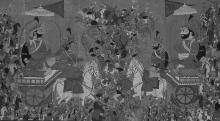
For many of us, Krishna is the epitome of sanatana dharma. His every thought, word, and action embodies the spirit of Hinduism. It is no surprise that his wartime counsel to Arjuna is revered as the greatest summary of Hindu thought. We can never be sure if Krishna spoke the exact words of the Bhagavad-Gita as we know it today, but it seems likely that at least the core message of the text was spoken by Krishna. We have all been in situations where a despondent friend has asked us for advice.
Author:Shatavadhani Dr. R. Ganesh
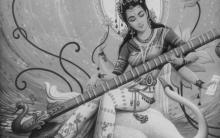
नीलोत्पल-दल-श्यामां विज्जिकां मामजानता ।
वृथैव दण्डिना प्रोक्ता सर्वशुक्ला सरस्वती ॥
nilotpala-dala-shyamam vijjikam mam ajanata |
vrthaiva dandina prokta sarvashukla sarasvati ||
Immadi Pulakeshi, the valiant ruler of the Chalukya dynasty, is the pride of all Kannadigas. Under his regime, the kingdom crossed many frontiers and extended its influence till the banks of Narmada. He was hailed as दक्षिणापथपरमेश्वर – the invincible emperor of the Southern land. He even defeated the mighty king Sriharsha.
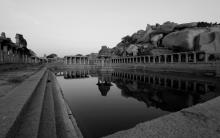
Vidyaranya ensured that different religious traditions of the land were given equal respect while not disturbing the peace in the empire. For a great empire to flourish, it needs more than military and political prowess. Only a robust cultural and social foundation can ensure that the people of a country remain united through troubles and turmoil. If a cursory look at today’s world can show us what kind of profound impact religion can have over a country, it is impossible to not see how religion ruled the worldview eight hundred years ago.
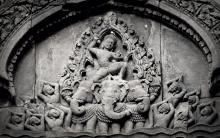
The Age of the Vedas: Indra – a great symbol for kshaatra
In the Vedas, Indra has been called Purandara. It means that he is the Indra who destroyed the puras of asuras. The word ‘pura’ can either mean the ‘forts’ of the enemies or their ‘bodies.’ Purandara is used in the sense of one who is capable of destroying the three kinds of shariras – स्थूल, सूक्ष्म, and कारण.

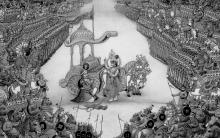
In 1962, the Marxist historian D D Kosambi published a work titled Myth and Reality: Studies in the Formation of Indian Culture (hereafter referred to as 'M&R'). The first part of the book is called ‘Social and Economic Aspects of the Bhagavad-Gita’ and deals with the philosophical, ethical, and historical aspects of the Gita.

An exploration into three fundamental but interrelated concepts in Indian philosophy: dharma (principle of sustenance), brahma (or brahman; Supreme spirit that pervades everything) and rasa (the aesthetic experience). While dharma is an efficient tool for managing life, rasa bridges the material and the spiritual, and brahma is the all-encompassing absolute.
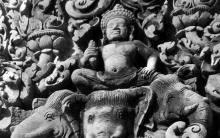
Since how long has the spirit of strength and courage been in the world? Indeed for thousands of years. In the Upanishads – the preeminent portion of the Vedas – we have a famous story of the creation of braahma, kshaatra, vaishya, and shudra along with dharma (Brhadaranyaka Upanishad 1.4). All the varnas arose from Prajapati (Brahma).
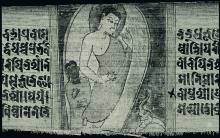
शुष्को वृक्षस्तिष्ठत्यग्रे
तदुपरि कश्चित्सर्पोऽप्यस्ति ।
नीरसतरुरिह विलसति निकटे
तदुपरि मणिमयकुटिलभुजङ्गः ॥
shushko vrkshastishthatyagre
tadupari kashchitsarpopyasti |
nirasataruriha vilasati nikate
tadupari manimayakutilabhujangah ||
An unfortunate outcome of the “modern” way of thinking–shaped by the all-are-equal assumption–is the fact that over the years, it has contributed to the reduction in the capacity of a society to produce heroes, role models etc. Today’s heroes derive from the entertainment, fashion, business and sports streams. Equally, the (primarily Marxist) widespread notion that all people–no matter what their genuine achievements are–are “subjects” to be “analysed,” has also hastened this reduction.