
Author:Hari Ravikumar

Kosambi hurls an accusation at Krishna for being the creator of the system of varnas –

“Not only that, the god himself had created such differences (G.4.13): “The four-caste (class) division has been created by Me”; this is proclaimed in the list of great achievements. The doctrines are certainly not timeless.” (Emphasis is mine)
(M&R, p.19)

While doing so, it is strange that Kosambi fails to quote the other half of the verse. The original verse, BG 4.13, says –
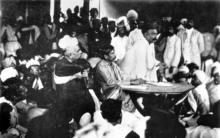
The Indian Councils Act of 1909 (popularly known as the Morley-Minto reforms) gave the Muslims of India a separate electorate. This was a strategy of the British to create a further rift between the Hindus and Muslims, which had already begun in 1905 when Bengal was partitioned on religious lines. Sharply criticizing this development, Aurobindo wrote (emphasis mine):

As a remarkable patriot, thinker, and visionary, Sri Aurobindo’s contributions to India are priceless. Unlike other patriots and leaders of his generation, it was in spite of his upbringing that Sri Aurobindo turned out to be such a devoted son to Mother India.

Enamored by the British, Aurobindo’s father Dr. Krishna Dhun Ghose did everything within his power to make his children grow up to be Englishmen. His dream was for his children to enter the Indian Civil Service and so the entire family moved to England in 1879, when Aurobindo was just 7.

In their years of exile, the Pandavas lived in the picturesque Dvaitavana abounding in beautiful trees and delicious fruits. One day, a deer carried away – between its antlers – the fire-producing sticks of a poor priest who was performing an important yajña. The priest came to the Pandavas seeking help. The five brothers took up their arms and went looking for the deer. Even after exhausting all their knowledge in hunting and combat, they were unable to catch the deer.

In the Vana Parva (Book 3) of the Mahabharata, during the course of Yudhistira’s discussion with sage Markandeya, the latter narrates the story of Kaushika and Dharmavyadha. It is a wonderful episode of how a learned ascetic obtains life-lessons from an unlettered butcher in Mithila.

Following a series of incidents, Kaushika lands up at the shop of Dharmavyadha, who is busy selling deer and buffalo meat. Seeing the ascetic, Dharmavyadha rises from his seat and walks up to him. “Welcome, O holy one! Come, let us go to my house.”

Long before Superman or Batman, there was Hanuman, the original superhero. But he wasn’t just all brawn. He was a consummate all-rounder. He was intelligent, patient, compassionate, ready to help, graceful, devoted to a larger cause, humble, and of course immensely strong. Born in a family of monkeys, to King Kesari and his wife Anjana, Hanuman grew up to be multi-skilled. His pivotal role in the Ramayana is known to many.

We have long had a fascination for the final answer, the Holy Grail, the Grand Unified Theory, the ultimate solution, and the quintessential element. Douglas Adams mocks this tendency in his masterpiece Hitchhiker’s Guide to the Galaxy (1979) by assigning a random number – 42 – to represent the answer to the meaning of life and everything else.

Vijayadashami – the victory on the tenth day – is when Rama killed Ravana. While the victory of Rama over Ravana was a great one, greater still are the several personal battles he fought and emerged victorious. Being the elder son, he was the natural choice for being the king, but he was sent into exile. He took it in his stride. After Sita was kidnapped, he pined for her and did not rest until he fought and killed Ravana. Then circumstances forced him to abandon his beloved wife. Caring little for his personal feelings, he acted according to the ruling.

Kosambi accuses the Bhagavad-Gita of being a perverse tool used by brahmanas to justify their actions:

We can evade taxes but can we do about death? Many of us have seen death from close quarters in our lives and those who have not, are most definitely aware of the idea. But imagine when the earliest humans experienced the death of someone around them. They would have seen one of their own people fall down, never to get up again. Their recognition of the phenomenon of death would have suddenly given them a definition for life. Until that time, there was nothing to delineate life. With the cognition of the phenomenon of death, suddenly there arose the awareness of a life-span.