

Often I come across people who say things like: “I’m not religious but I’m spiritual,” “I like the philosophy of Hinduism but I don’t know why we have all these rituals,” or “If we can rid our religion of all superstitions and rituals, then it would become relevant.” I must confess that at one point of time, I too had similar thoughts.
Author:Hari Ravikumar
Kosambi says that the Bhagavad-Gita verses 2.55-72 would not have been possible without the influence of Buddhism (M&R, p. 20). There are three reasons why this statement is absolutely false:

Kosambi goes on to question the veracity of the Mahabharata’s claim on the numbers:
“If a Mahabharata war had actually been fought on the scale reported, nearly five million fighting men
killed each other in an 18-day battle between Delhi and Thanesar…”
(M&R, p. 17)
Sukanta Bhattacharya (1926-1947) is counted as one of the great Bengali poets along with Rabindranath Tagore, Jibanananda Das, and Kazi Nazrul. For someone who died at twenty, that is quite something. Many of his poems have sociopolitical undertones but are romantic at the core.

If you grew up in India or if you were associated with Indian culture in any form – literature, music, dance, or films – you would have heard the word dharma. Most Indian languages have this word as is or at least have the concept (for example, in Tamil, we use the word aram, which is similar to dharma).
After briefly referring to some commentators on the Gita—including Shankara, Ramanuja, Jnaneshvar, Tilak, Aurobindo, and Gandhi—Kosambi again raises the question as to how the same text could appeal to different people in different ways. He concludes his rant with these ridiculous lines:

Subramanya 'Bharathi' (1882-1921) or 'Mahakavi Bharathiar' was among the foremost of modern Tamil poets. He was not only a poet but also a journalist, social activist, and freedom fighter. His poems covered a wide variety of topics and many of them are even sung as classical compositions.
The first poem of Bharathiar that I learnt was one that he wrote during the freedom struggle. It is a stirring poem that exhorts his compatriots to fearlessly face the British. The poem in Tamil goes:

Subhadra Kumari Chauhan (1904-1948) was a renowned Hindi poet and freedom fighter. Her pièce de résistance is her epic poem on the Queen of Jhansi, Lakshmibai. While she was known for her poems in the vira rasa (the aesthetic experience of courage; one of the nine rasas), this is a beautiful poem about childhood in the karuna rasa (the aesthetic experience of compassion, pathos, and empathy).

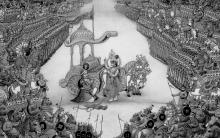
In 1962, the Marxist historian D D Kosambi published a work titled Myth and Reality: Studies in the Formation of Indian Culture (hereafter referred to as 'M&R'). The first part of the book is called ‘Social and Economic Aspects of the Bhagavad-Gita’ and deals with the philosophical, ethical, and historical aspects of the Gita.