Author:Raghavendra G S

One of the stories of Sri Ramakrishna

Whenever I remember Bindu Rao, a story that Bhagavān Ramakrishna Paramahamsa often narrated comes to my mind. 

A scholar approached a king with request to help. The king asked him, “What is your area of scholarship?”

The scholar replied, “I expound the Śrīmad-Bhāgavata.”

“Is that so? That is good to know! I’m curious to listen to the Bhāgavata-purāṇa. But I’m not at leisure today. If you’re here next Saturday, I will be able to sit and listen.”

किं वेदैः स्मृतिभिः पुराणपठनैः शास्त्रैर्महाविस्तरैः

स्वर्गग्रामकुटीनिवासफलदैः कर्मक्रियाविभ्रमैः।

मुक्त्वैकं भवबन्धदुःखरचनाविध्वंसकालानलं

स्वात्मानन्दपदप्रवेशकलनं शेषा वणिग्वृत्तयः॥

BasavanagudiClub

Basavanagudi Club

I've mentioned earlier that Venkatanaranappa was unassuming, disciplined, honest, dispassionate, and hard-working. There were, however, a couple of qualities that were unusual for a person of his stature, namely friendliness and humorous nature. Though he was conservative and religious in certain matters, tenderness that is innate to humans was not a rare quality in him. He desired to have the constant company of friends, comedy filled with wit, and regular association with other humans.

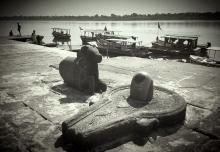
Narmada Shiva Linga

The true root and heart of Mandra is located in the music of Raja Saheb and his small Mahadeva Temple overlooking the perennial, gurgling currents of Narmada River amid the dense jungle he has specially grown. In less than ten pages, Dr. Bhyrappa unveils a majestic opulence that at once encompasses the highest and the best traditions of Indian music, its underlying philosophy, its aesthetic goal and its ultimate ideal.

The story of the Mahābhārata is gigantic. It is thus divided into eighteen parvas. These divisions are called kāṇḍas in the Rāmāyaṇa. What is termed as ‘sandhi’ in later works such as Jaiminī-bhārata corresponds to an adhyāya. Several adhyāyas together constitute a parva. The word ‘parva’ means a span between two nodes of a sugarcane. Just like the span between nodes in a sugarcane stalk, so also is the role played by the parvas in the Mahābhārata.

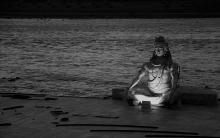
Bhartṛhari begins his Vairāgya-śatakam with a verse on Śiva:

            चूडोत्तंसितचारुचन्द्रकलिकाचञ्चच्छिकाभास्वरो

लीलादग्धविलोलकामशलभः श्रेयोदशाग्रे स्फुरन्।

अन्तःस्फूर्जदपारमोहतिमिरप्राग्भारमुच्चाटयं-

श्चेतःसद्मनि योगिनां विजयते ज्ञानप्रदीपो हरः॥

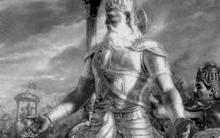
On the fourth day of the war, Bhīmasena totally destroyed Duryodhana’s elephant division and killed eight of the Kaurava brothers including Jalasandha and Suṣeṇa. Bhagadatta climbed onto a huge elephant in rut and fought relentlessly with Bhīmasena; he shot a flood of arrows and made Bhīma faint. At that point Ghaṭotkaca came forward and struck a severe blow to Bhagadatta’s elephant. Listening to the elephant howling in pain, Bhīṣma and others rushed to Bhagadatta’s aid.

Ask a random student of Sanskrit to recite a poem—chances are you will hear a verse from Bhartṛhari’s Nīti-śatakam. Go to an Acharya seeking wise counsel—chances are you will hear a verse from Bhartṛhari’s Vairāgya-śatakam. Suppose you are interested in love as it is depicted in Sanskrit literature and consult a book—chances are you will come across a verse from Bhartṛhari’s Śṛṅgāra-śatakam. Such is our poet’s popularity.

Beginning of Bhārata-vācana

This group of literary and musical connoisseurs made it a routine to take turns and meet in one of the houses every day after work, once they freshened up. H Nagesh Rao was a tenant at Mirmira Rama Rao’s house on Arcot Srinivasacharya Road. I’ve been a part of this group meeting many times. Venkatakrishnappa would usually sing something. Someone else would chant a Śloka. Bindu Rao would recite the Bhārata. I still wasn’t acquainted with Bindu Rao back then.