Author:Shatavadhani Dr. R. Ganesh

The Sanskrit Language

Our ancients sculpted a language to give perfect expression to their exuberant emotions. It has a well-developed scheme of letters and an inbuilt etymological structure that has endowed it with variety and a rare word-generation power. Being an inflected language, it is not tied down by a linear pattern of word order. It is thus highly flexible[1].
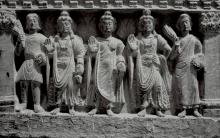
Pushyamitra Shunga tried to liberate Bharata’s lands under Greek occupation. The Greek invasion that began with Alexander continued till the time of Menander. The same Menander came to be known as Milindara later. Buddhists texts mention his name. The dialogue between Nagasena and Menander is recorded in the Pali (Magadhi) text ‘Milinda Panho.’ For a prolonged period—nearly three hundred years—the Ionian incursions were a recurring feature.

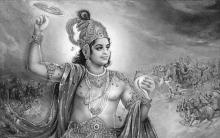
As individuals, we can be utterly honest and upright. But that will not work at the societal realm. A public figure will have to resort to strategies. We see Krishna’s brilliance and foresight throughout. Long before he befriended the Pandavas, he was laying out a strategy for change.

Around 1925-26, I had been to Delhi to undertake a political study--to gain knowledge about the condition, status, and the future of India's Princely States.  I met Captain Ajab Khan to gather information about the army and other personnel employed by the Princely States. Ajab Khan hailed from Punjab. He had served as a Commander of one of the units engaged in the First World War (1914-18). He had been nominated as a Member of the then Rajya Sabha.

Viśvanātha who wrote Sāhityadarpaṇa starts off by criticizing the attributes of poetry as described by Mammaṭa and others, and ridicules the suggestion that comes from the topic or the object of poetry. Such suggestion, in his opinion, cannot be poetry. From his perspective, sentences filled with emotion make up poetry and nothing else, for:
देवदत्तो ग्रामं याति इति वाक्ये तद्भृत्यस्य तदनुसरणरूपव्यङ्ग्यावगतेरपि काव्यं स्यात्!
(Sāhityadarpaṇa Vṛtti 1.2)

Moving on to one of the greatest masters of all schools of thought and a very creative and gifted genius Abhinavagupta, we see humour sparkling aptly in both his excellent and incomparable commentaries Abhinavabhāratī (on the Nāṭyaśāstra) and Locana (on the Dhvanyāloka). Both his works, along with excellent usage of Sanskrit, portray a beautiful style of writing interspersed with his natural penchant for humour and thus is a source of joy for rasikas.

जगत्सन्दर्भसौन्दर्यसंवित्संस्पन्दसाक्षिणम्।
प्रणमामि सितस्मेरप्रणवं गणनायकम् ॥

The author wrote this open letter as part of a recent assignment. The letter summarises and adds to his earlier essays on related topics. The assignment was to “Imagine that the Prime Minister has sought your advice for institutionalising Ayurveda in India and abroad. He wants you to tell him the current challenges and solutions to overcome them.” – Editors

Dear Prime Minister,

Back at Hastināpura, Gāndhārī too was pregnant; even as she was carrying, she heard that Kuntī had given birth to Yudhiṣṭhira. She hadn’t given birth even after two years of pregnancy; the pain was unbearable too. So one day, extremely upset, she squeezed her abdomen and pushed out the foetus. The foetus came out as a ball of flesh. “Is this what Īśvara blessed has me with in the past; is this what Vyāsa promised!” Thinking thus with disgust, she was about to throw the ball of flesh away.