The Essential Sanātana-dharma - Creation and Dissolution, Space and Time

Creation and Dissolution

The Sanskrit word for creation is sṛṣṭi, which means ‘pouring forth.’ In other words, it is not ‘creation’ but rather an outpouring, an expansion, an expression. In the Vedas, the concept of Creation is discussed in various ways. One hymn (Nāsadīya-sūkta[1]) proposes a brilliant conceptual model for creation while another (Hiraṇyagarbha-sūkta[2]) raises and answers many questions about the creator and creation. Yet another hymn (Puruṣa-sūkta[3]) describes in detail the process of creation. There are several creation hymns in the Vedas. Amidst all these varied views, there is a single underlying idea: ‘one became everything.’

In the Vedic songs of creation, we find attempts at establishing the connection between macrocosm and microcosm—how one came from the other as well as their various manifestations.[4]

Starting from our tiny individual selves to huge galaxies floating about in space, we see the cycle of creation, life, and dissolution. In our own body, cells are born and die every single day. In the life of an individual, there is physical birth and death. The same applies to dynasties, kingdoms, civilizations as it does to rivers, mountains, planets, and stars.

This process of coming into being, sustaining, and dissolving into non-existence (only to come back into being later on) is the eternal cycle of sṛṣṭi, sthiti, and laya.

Sṛṣṭi means ‘pouring forth,’ ‘expression,’ ‘existence of properties,’ ‘emergence,’ ‘expansion,’ ‘creation’ – this corresponds to birth.

Sthiti means ‘maintenance,’ ‘sustenance,’ ‘steadiness,’ ‘equilibrium,’ ‘balance’ – this corresponds to living.

Laya (or pralaya) means ‘dissolution,’ ‘annihilation,’ ‘disappearance,’ ‘destruction,’ ‘withdrawal’ – this corresponds to death.

Creation, therefore, is not a one-off activity. It is not absolute. It is not an end in itself. It is constant and ongoing, as are maintenance and dissolution. Without beginning and without end, from an atom to the entire universe, from a microsecond to billions of millennia, everything is subject to the eternal cycle of sṛṣṭi-sthiti-laya.

To a jīvanmukta, this cycle of sṛṣṭi-sthiti-laya is a cosmic play[5], a divine dance, just to be enjoyed. In fact, many of our festivals, rituals, and arts revolve around re-enactment of this cosmic play.

Space and Time

We saw earlier that Sanātana-dharma is inspired by nature. While drawing from nature, the seers further refined it rather than artificially concocting a new system. We see this even in the Hindu conception of Time. Our ancient savants observed the world around them and realized that time is cyclical rather than linear – night follows day, the fortnightly phase of the waning moon is followed by that of the waxing moon, the seasons come one after another, and so on. The Hindu timeline spans trillions of years and we have eternal time cycles one after the other with no beginning or end.

The basic concept is that twelve months make a year; this equals a day and night of the devas.* 360 days and nights of the devas make a deva year. 12,000 deva years make one mahā-yuga (‘Great Age’). A day of Brahmā (deity of creation) spans 1,000 mahā-yugas; a night of Brahmā also spans a thousand mahā-yugas. Brahmā’s life span is 100 Brahmā years.[6]

A māha-yuga is made up of four yugas – Satya-yuga or Kṛta-yuga (17,28,000 years), Tretā-yuga (12,96,000 years), Dvāpara-yuga (8,64,000 years), and Kali-yuga (4,32,000 years).[7] In human terms, a māha-yuga spans 4.32 million years. A day of Brahmā across a thousand mahā-yugas and equals 4.32 billion human years, the time he is active and thus enables activity in the universe. This period is deemed a cosmic cycle. During the night of Brahmā, which also spans the same period, the whole of creation is dissolved only to be brought forth again at the beginning of the next day (i.e. the next cosmic cycle).[8]

The notion of space is similarly superlative in Hinduism. The universe is traditionally divided into three realms[9] – earth, sky, and heavens, but there are other kinds of divisions of space. Texts of ritual speak of fourteen worlds – seven above and seven below, with the middle one being the earth – in the ‘infinite egg-shaped cosmos.’[10] On earth, seven islands (dvīpas) are identified; each island is divided into nine subcontinents (varṣas); each subcontinent is divided into nine provinces (khaṇḍas). They mention ten forests, thirty-five rivers (seven main rivers with five tributaries each), and seven mighty mountain ranges found in Bhārata (belonging to Jambū-dvīpa, Bhārata-varṣa, Bharata-khaṇḍa).

This division of space and time is metaphorical and must not be taken literally. It merely serves to give us an image of the spatiotemporal vastness of the universe. This massive scale of space and time with all its staggering details is recited in a poetic format as a part of the mahā-saṅkalpa and is presented on many ceremonial occasions.


[1] Ṛg-veda-saṃhitā 10.129

[2] Ṛg-veda-saṃhitā 10.121

[3] Ṛg-veda-saṃhitā 10.90

[4] A common motif in the Vedic creation songs is the connection between the brahmāṇḍa (macrocosm) and the piṇḍāṇda (microcosm) – Aitareyopaniṣad 1.1.4, 1.2.4; Śatapatha-brāhmaṇa 6.1.1.3, 6.1.1.11; Bṛhadāraṇyakopaniṣad 1.1.1; Chāndogyopaniṣad 3.19.2, etc.While the pañca-bhūtas (five elements – space, fire, earth, air, and water) pertain to the brahmāṇḍa, the pañca-tanmātras (five essences – sound, form, smell, touch, and taste) relate to the piṇḍāṇda. For more on creation as seen in the Vedas, see Srishti: Songs of Creation from the Vedas by Koti Sreekrishna and Hari Ravikumar (Mason: W.I.S.E. Words Inc., 2015).

[5] The cosmic play of the Supreme is called līlā (See Brahma-sūtra 2.1.33 – “lokavat-tu līlā-kaivalyam”).

[6] Sūrya-siddhānta 1.13–21

[7] From an anthropological perspective, Kṛta-yuga represents the age of travelling nomads and hunter-gatherers; a time when man owned little; a time of complete dependence on nature and therefore no need for human law.

Tretā-yuga represents the age of the settlers; a time when man started agriculture and began habitation in communities. The Upavedas must have developed during this era – health, law and order (as well as politics, economics), art (for entertainment), and architecture (temples, houses) became important.

Dvāpara-yuga represents the age of kingdoms; a time when man could traverse greater distances and conduct trade in a far more expansive geography; a period during which wars became more and more common.

Kali-yuga represents the age of urbanization; a time when all aspects of life attain greater sophistication and simultaneously, greater corruption and degradation.

Since each successive age is tending more towards adharma, the corresponding length of the era is also lesser.

There is also a conception of realising the four yugas in our own lives – Kali-yuga is equated with sleep, Dvāpara with sitting down, Tretā with standing up, and Kṛta with moving about (“…kaliḥ śayāno bhavati saṃjihānastu dvāparaḥ, uttiṣṭhaṃstretā bhavati kṛtaṃ saṃpadyate caran” —Aitareya-brāhmaṇa 7.15.4).

[8] One cosmic cycle (known as ‘kalpa’) accommodates fourteen manvantaras, each of which is governed by a Manu. The term ‘manu’ refers to ‘a progenitor of humanity’ in general, and to the fourteen rulers of one kalpa in specific.

[9] The earth (pṛthivī) is called bhūḥ, the sky (antarikṣa) is called bhuvaḥ, and the heavens (dyauḥ) are called svaḥ or suvaḥ.

[10]ananta-koṭi brahmāṇḍa.’

To be continued.


Author(s)

About:

Dr. Ganesh is a 'shatavadhani' and one of India’s foremost Sanskrit poets and scholars. He writes and lectures extensively on various subjects pertaining to India and Indian cultural heritage. He is a master of the ancient art of avadhana and is credited with reviving the art in Kannada. He is a recipient of the Badarayana-Vyasa Puraskar from the President of India for his contribution to the Sanskrit language.

About:

Hari is an author, translator, editor, designer, and violinist with a deep interest in philosophy, education pedagogy, literature, and films. He has (co-)written/translated and (co-)edited some forty books, mostly related to Indian culture.

Prekshaa Publications

Karnataka’s celebrated polymath, D V Gundappa brings together in the eighth volume of reminiscences character sketches of his ancestors teachers, friends, etc. and portrayal of rural life. These remarkable individuals hailing from different parts of South India are from the early part of the twentieth century. Written in Kannada in the 1970s, these memoirs go beyond personal memories and offer...

Karnataka’s celebrated polymath, D V Gundappa brings together in the seventh volume of reminiscences character sketches of prominent scholars, businessmen, hoteliers, as well as of the laity. These remarkable individuals hailing from different parts of South India are from the early part of the twentieth century. Written in Kannada in the 1970s, these memoirs go beyond personal memories and...

Poets on Poetics: Literary Aesthetics Envisioned by Sanskrit Poets uncovers the tenets of literary theory conceptualized by masters from Bharata to Jagannātha that are embedded in the works of poets from Vālmīki to Nīlakaṇṭha-dīkṣita. Poets typically present their insights in the form of suggestive verses and rarely as an organized body of facts. Their exposition, inchoate though it might seem...

India is a land of stories. It is a fountainhead of various story-telling traditions of Greater India, Asia, and Europe. The now lost Bṛhat-kathā of Guṇāḍhya was an inexhaustible treasure-trove of stories that influenced generations of listeners. Somadeva’s Kathā-sarit-sāgara is a twelfth century Sanskrit retelling of this grand compendium. To read this work is to understand the heart of the...

Among the many contributions of ancient Indians to world thought, perhaps the most insightful is the realisation that ānanda (Bliss) is the ultimate goal of human existence. Since time immemorial, India has been a land steeped in contemplation about the nature of humans and the universe. The great ṛṣis (seers) and ṛṣikās (seeresses) embarked on critical analysis of subjective experience and...

One of the two great epics of India and arguably the most popular epic in the world, the Ramayana has enchanted generations of people not just in Greater India but the world over. In less than three hundred pages The Essential Ramayana captures all the poetic subtleties and noble values of the original and offers the great epic in an eminently readable form that will appeal to the learned and...

The Bhagavad-gītā isn’t merely a treatise on ultimate liberation. It is also a treatise on good living. Even the laity, which does not have its eye on mokṣa, can immensely benefit from the Gītā. It has the power to grant an attitude of reverence in worldly life, infuse enthusiasm in the execution of duty, impart fortitude in times of adversity, and offer solace to the heart when riddled by...

Indian Perspective of Truth and Beauty in Homer’s Epics is a unique work on the comparative study of the Greek Epics Iliad and Odyssey with the Indian Epics – Rāmāyaṇa and Mahābhārata. Homer, who laid the foundations for the classical tradition of the West, occupies a stature similar to that occupied by the seer-poets Vālmīki and Vyāsa, who are synonymous with the Indian culture. The author...

Karnataka’s celebrated polymath, D V Gundappa brings together in the sixth volume of reminiscences character sketches of prominent public figures, liberals, and social workers. These remarkable personages hailing from different corners of South India are from a period that spans from the late nineteenth century to the mid-twentieth century. Written in Kannada in the 1970s, these memoirs go...

An Introduction to Hinduism based on Primary Sources

Authors: Śatāvadhānī Dr. R Ganesh, Hari Ravikumar

What is the philosophical basis for Sanātana-dharma, the ancient Indian way of life? What makes it the most inclusive and natural of all religio-philosophical systems in the world?

The Essential Sanātana-dharma serves as a handbook for anyone who wishes to grasp the...

Karnataka’s celebrated polymath, D V Gundappa brings together in the fifth volume, episodes from the lives of traditional savants responsible for upholding the Vedic culture. These memorable characters lived a life of opulence amidst poverty— theirs  was the wealth of the soul, far beyond money and gold. These vidvāns hailed from different corners of the erstwhile Mysore Kingdom and lived...
Padma Bhushan Dr. Padma Subrahmanyam represents the quintessence of Sage Bharata’s art and Bhārata, the country that gave birth to the peerless seer of the Nāṭya-veda. Padma’s erudition in various streams of Indic knowledge, mastery over many classical arts, deep understanding of the nuances of Indian culture, creative genius, and sublime vision bolstered by the vedāntic and nationalistic...

Bhārata has been a land of plenty in many ways. We have had a timeless tradition of the twofold principle of Brāhma (spirit of wisdom) and Kṣāttra (spirit of valour) nourishing and protecting this sacred land. The Hindu civilisation, rooted in Sanātana-dharma, has constantly been enriched by brāhma and safeguarded by kṣāttra.
The renowned Sanskrit poet and scholar, Śatāvadhānī Dr. R...

ಛಂದೋವಿವೇಕವು ವರ್ಣವೃತ್ತ, ಮಾತ್ರಾಜಾತಿ ಮತ್ತು ಕರ್ಷಣಜಾತಿ ಎಂದು ವಿಭಕ್ತವಾದ ಎಲ್ಲ ಬಗೆಯ ಛಂದಸ್ಸುಗಳನ್ನೂ ವಿವೇಚಿಸುವ ಪ್ರಬಂಧಗಳ ಸಂಕಲನ. ಲೇಖಕರ ದೀರ್ಘಕಾಲಿಕ ಆಲೋಚನೆಯ ಸಾರವನ್ನು ಒಳಗೊಂಡ ಈ ಹೊತ್ತಗೆ ಪ್ರಧಾನವಾಗಿ ಛಂದಸ್ಸಿನ ಸೌಂದರ್ಯವನ್ನು ಲಕ್ಷಿಸುತ್ತದೆ. ತೌಲನಿಕ ವಿಶ್ಲೇಷಣೆ ಮತ್ತು ಅಂತಃಶಾಸ್ತ್ರೀಯ ಅಧ್ಯಯನಗಳ ತೆಕ್ಕೆಗೆ ಬರುವ ಬರೆಹಗಳೂ ಇಲ್ಲಿವೆ. ಶಾಸ್ತ್ರಕಾರನಿಗಲ್ಲದೆ ಸಿದ್ಧಹಸ್ತನಾದ ಕವಿಗೆ ಮಾತ್ರ ಸ್ಫುರಿಸಬಲ್ಲ ಎಷ್ಟೋ ಹೊಳಹುಗಳು ಕೃತಿಯ ಮೌಲಿಕತೆಯನ್ನು ಹೆಚ್ಚಿಸಿವೆ. ಈ...

Karnataka’s celebrated polymath, D V Gundappa brings together in the fourth volume, some character sketches of the Dewans of Mysore preceded by an account of the political framework of the State before Independence and followed by a review of the political conditions of the State after 1940. These remarkable leaders of Mysore lived in a period that spans from the mid-nineteenth century to the...

Bharatiya Kavya-mimamseya Hinnele is a monograph on Indian Aesthetics by Mahamahopadhyaya N. Ranganatha Sharma. The book discusses the history and significance of concepts pivotal to Indian literary theory. It is equally useful to the learned and the laity.

Sahitya-samhite is a collection of literary essays in Kannada. The book discusses aestheticians such as Ananda-vardhana and Rajashekhara; Sanskrit scholars such as Mena Ramakrishna Bhat, Sridhar Bhaskar Varnekar and K S Arjunwadkar; and Kannada litterateurs such as DVG, S L Bhyrappa and S R Ramaswamy. It has a foreword by Shatavadhani Dr. R Ganesh.

The Mahābhārata is the greatest epic in the world both in magnitude and profundity. A veritable cultural compendium of Bhārata-varṣa, it is a product of the creative genius of Maharṣi Kṛṣṇa-dvaipāyana Vyāsa. The epic captures the experiential wisdom of our civilization and all subsequent literary, artistic, and philosophical creations are indebted to it. To read the Mahābhārata is to...

Shiva Rama Krishna

சிவன். ராமன். கிருஷ்ணன்.
இந்திய பாரம்பரியத்தின் முப்பெரும் கதாநாயகர்கள்.
உயர் இந்தியாவில் தலைமுறைகள் பல கடந்தும் கடவுளர்களாக போற்றப்பட்டு வழிகாட்டிகளாக விளங்குபவர்கள்.
மனித ஒற்றுமை நூற்றாண்டுகால பரிணாம வளர்ச்சியின் பரிமாணம்.
தனிநபர்களாகவும், குடும்ப உறுப்பினர்களாகவும், சமுதாய பிரஜைகளாகவும் நாம் அனைவரும் பரிமளிக்கிறோம்.
சிவன் தனிமனித அடையாளமாக அமைகிறான்.
ராமன்...

ऋतुभिः सह कवयः सदैव सम्बद्धाः। विशिष्य संस्कृतकवयः। यथा हि ऋतवः प्रतिसंवत्सरं प्रतिनवतामावहन्ति मानवेषु तथैव ऋतुवर्णनान्यपि काव्यरसिकेषु कामपि विच्छित्तिमातन्वते। ऋतुकल्याणं हि सत्यमिदमेव हृदि कृत्वा प्रवृत्तम्। नगरजीवनस्य यान्त्रिकतां मान्त्रिकतां च ध्वनदिदं चम्पूकाव्यं गद्यपद्यमिश्रितमिति सुव्यक्तमेव। ऐदम्पूर्वतया प्रायः पुरीपरिसरप्रसृतानाम् ऋतूनां विलासोऽत्र प्रपञ्चितः। बेङ्गलूरुनामके...

The Art and Science of Avadhānam in Sanskrit is a definitive work on Sāhityāvadhānam, a form of Indian classical art based on multitasking, lateral thinking, and extempore versification. Dotted throughout with tasteful examples, it expounds in great detail on the theory and practice of this unique performing art. It is as much a handbook of performance as it is an anthology of well-turned...

This anthology is a revised edition of the author's 1978 classic. This series of essays, containing his original research in various fields, throws light on the socio-cultural landscape of Tamil Nadu spanning several centuries. These compelling episodes will appeal to scholars and laymen alike.
“When superstitious mediaevalists mislead the country about its judicial past, we have to...

The cultural history of a nation, unlike the customary mainstream history, has a larger time-frame and encompasses the timeless ethos of a society undergirding the course of events and vicissitudes. A major key to the understanding of a society’s unique character is an appreciation of the far-reaching contributions by outstanding personalities of certain periods – especially in the realms of...

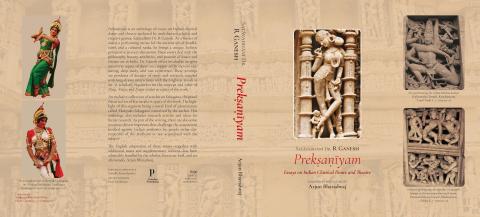
Prekṣaṇīyam is an anthology of essays on Indian classical dance and theatre authored by multifaceted scholar and creative genius, Śatāvadhānī Dr. R Ganesh. As a master of śāstra, a performing artiste (of the ancient art of Avadhānam), and a cultured rasika, he brings a unique, holistic perspective to every discussion. These essays deal with the philosophy, history, aesthetics, and practice of...

Yaugandharam

इदं किञ्चिद्यामलं काव्यं द्वयोः खण्डकाव्ययोः सङ्कलनरूपम्। रामानुरागानलं हि सीतापरित्यागाल्लक्ष्मणवियोगाच्च श्रीरामेणानुभूतं हृदयसङ्क्षोभं वर्णयति । वात्सल्यगोपालकं तु कदाचिद्भानूपरागसमये घटितं यशोदाश्रीकृष्णयोर्मेलनं वर्णयति । इदम्प्रथमतया संस्कृतसाहित्ये सम्पूर्णं काव्यं...

Vanitakavitotsavah

इदं खण्डकाव्यमान्तं मालिनीछन्दसोपनिबद्धं विलसति। मेनकाविश्वामित्रयोः समागमः, तत्फलतया शकुन्तलाया जननम्, मातापितृभ्यां त्यक्तस्य शिशोः कण्वमहर्षिणा परिपालनं चेति काव्यस्यास्येतिवृत्तसङ्क्षेपः।

Vaiphalyaphalam

इदं खण्डकाव्यमान्तं मालिनीछन्दसोपनिबद्धं विलसति। मेनकाविश्वामित्रयोः समागमः, तत्फलतया शकुन्तलाया जननम्, मातापितृभ्यां त्यक्तस्य शिशोः कण्वमहर्षिणा परिपालनं चेति काव्यस्यास्येतिवृत्तसङ्क्षेपः।

Nipunapraghunakam

इयं रचना दशसु रूपकेष्वन्यतमस्य भाणस्य निदर्शनतामुपैति। एकाङ्करूपकेऽस्मिन् शेखरकनामा चित्रोद्यमलेखकः केनापि हेतुना वियोगम् अनुभवतोश्चित्रलेखामिलिन्दकयोः समागमं सिसाधयिषुः कथामाकाशभाषणरूपेण निर्वहति।

Bharavatarastavah

अस्मिन् स्तोत्रकाव्ये भगवन्तं शिवं कविरभिष्टौति। वसन्ततिलकयोपनिबद्धस्य काव्यस्यास्य कविकृतम् उल्लाघनाभिधं व्याख्यानं च वर्तते।

Karnataka’s celebrated polymath, D V Gundappa brings together in the third volume, some character sketches of great literary savants responsible for Kannada renaissance during the first half of the twentieth century. These remarkable...

Karnataka’s celebrated polymath, D V Gundappa brings together in the second volume, episodes from the lives of remarkable exponents of classical music and dance, traditional storytellers, thespians, and connoisseurs; as well as his...

Karnataka’s celebrated polymath, D V Gundappa brings together in the first volume, episodes from the lives of great writers, poets, literary aficionados, exemplars of public life, literary scholars, noble-hearted common folk, advocates...

Evolution of Mahabharata and Other Writings on the Epic is the English translation of S R Ramaswamy's 1972 Kannada classic 'Mahabharatada Belavanige' along with seven of his essays on the great epic. It tells the riveting...

Shiva-Rama-Krishna is an English adaptation of Śatāvadhāni Dr. R Ganesh's popular lecture series on the three great...

Bharatilochana

ಮಹಾಮಾಹೇಶ್ವರ ಅಭಿನವಗುಪ್ತ ಜಗತ್ತಿನ ವಿದ್ಯಾವಲಯದಲ್ಲಿ ಮರೆಯಲಾಗದ ಹೆಸರು. ಮುಖ್ಯವಾಗಿ ಶೈವದರ್ಶನ ಮತ್ತು ಸೌಂದರ್ಯಮೀಮಾಂಸೆಗಳ ಪರಮಾಚಾರ್ಯನಾಗಿ  ಸಾವಿರ ವರ್ಷಗಳಿಂದ ಇವನು ಜ್ಞಾನಪ್ರಪಂಚವನ್ನು ಪ್ರಭಾವಿಸುತ್ತಲೇ ಇದ್ದಾನೆ. ಭರತಮುನಿಯ ನಾಟ್ಯಶಾಸ್ತ್ರವನ್ನು ಅರ್ಥಮಾಡಿಕೊಳ್ಳಲು ಇವನೊಬ್ಬನೇ ನಮಗಿರುವ ಆಲಂಬನ. ಇದೇ ರೀತಿ ರಸಧ್ವನಿಸಿದ್ಧಾಂತವನ್ನು...

Vagarthavismayasvadah

“वागर्थविस्मयास्वादः” प्रमुखतया साहित्यशास्त्रतत्त्वानि विमृशति । अत्र सौन्दर्यर्यशास्त्रीयमूलतत्त्वानि यथा रस-ध्वनि-वक्रता-औचित्यादीनि सुनिपुणं परामृष्टानि प्रतिनवे चिकित्सकप्रज्ञाप्रकाशे। तदन्तर एव संस्कृतवाङ्मयस्य सामर्थ्यसमाविष्कारोऽपि विहितः। क्वचिदिव च्छन्दोमीमांसा च...

The Best of Hiriyanna

The Best of Hiriyanna is a collection of forty-eight essays by Prof. M. Hiriyanna that sheds new light on Sanskrit Literature, Indian...

Stories Behind Verses

Stories Behind Verses is a remarkable collection of over a hundred anecdotes, each of which captures a story behind the composition of a Sanskrit verse. Collected over several years from...