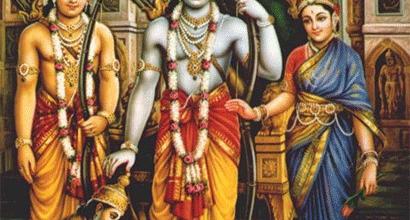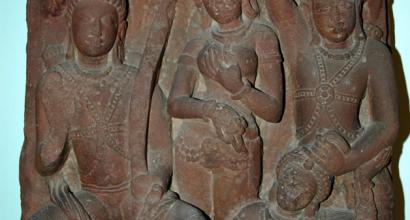
From the Uttara-kāṇḍa of Vālmīki’s Rāmāyaṇa, we learn that Rāma had made up his mind to perform the aśvamedha accompanied by the golden image of Sītā. He does not expect Sītā to perform a śapatha, i.e., take an oath as per his whims. In fact, Vālmīki suggests the act. Bhū-devī does not come to take her away either, but instead, declares her pātivratya before the people gathered there. The current play does not contain the details of Rāma killing Śambūka, Śatrughna vanquishing Lavaṇāsura, and Rāma and Lakṣmaṇa engaging in a war with the twin boys; the play is quite concise. The play summarises the events until Sītā-parityāga in about ten verses only. Aho saṅkṣepaḥ! The poet probably intends to indicate that Vālmīki composed the Rāmāyaṇa and had Lava and Kuśa recite it, to the accompaniment of vīṇā, before Rāma to see how his heart changes. How can one even imagine bringing the entire Rāmāyaṇa on the stage? The events that unfolded after Sītā-parityāga are captured by a sage named Kaṇva in just about three verses. The young Lava and Kuśa, however, did not know this part of the story. Though the boys had heard of Rāma, Lakṣmaṇa, and Sītā in the epic, they did not know these people in person. The senior residents of Vālmīki’s āśrama addressed Sītā as vadhū, and the others called her devī. Whenever there was a reference to Rāma, she had called him niranukrośa, i.e., heartless. As the boys were still young and naïve, they did not give much thought to her words. Sītā was, in fact, with her sons as they were performing the epic before the king; she, thus, even sees Rāma. Rāma, too, hopes and suspects that the children are his offspring and that the lady there was his beloved, Sītā. When the children, all by surprise, learn that Sītā and Rāma are their parents, they must have been amazed and happy; it is unlikely that their father and mother experienced similar emotions. This segment of the play bears semblance to the seventh act of the Śākuntala in its dramatic element.
Sītā and Rāma have their eyes on their sons; it is for their sake that Sītā does not commit suicide. She offered the kundamālā to the river Gaṅgā to have a trouble-free delivery; she nurtured them and contributed to their growth. She did not choose to go away into the earth, depriving them of motherly affection. She ensured that the children grew up well in Vālmīki’s āśrama and received a good education; they studied well and were humble as well; they developed immense courage and gained the qualities to become responsible princes and kings, later on. The poet does not tell us if Rāma eventually performed the yāga, or if he ruled the kingdom or went into vanaprastha. Though Rāma and Sītā experience immense pain, they tolerate it with great forbearance. As Sītā learnt of her abandonment all of a sudden, she underwent quite some agony and was unhappy with Rāma; her primary complaint is that if it was right on his part to display that kind of niranukrośa – lack of compassion. Nevertheless, their love did not deteriorate; even though they were separated for twelve years, Rāma recognises the floral garland strung by Sītā and identifies her footsteps; he picks her uttarīya and wears it. Sītā’s devotion to her husband and their unconditional and untainted love finally yielded good fruits. Thus, the play, which begins with karuṇa-rasa ends adbhuta-rasa; jasmine flowers of marital love and affection towards children are strung into a fragrant garland and offered to the river of life.
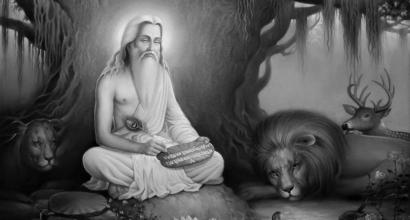
There are limitations to the characters in the play. Kausalyā and the other women are behind the screen as women of antaḥpura. The citizens, kings, Vibhīṣaṇa, and others are behind the scenes as well. As required by the dramatic tradition, the vidūṣaka comes on to the stage; however, he does not contribute much to hāsya; in fact, his presence does not contribute much to the play. Vālmīki is the adhi-devatā of the play; all events take place in the vicinity of his āśrama and mostly involve his students. Vasiṣṭha and the other maharṣis are not present either.
The following verses can help give an idea about the linguistic style of the play –
एते रुदन्ति हरिणा हरितं विमुच्य
हंसाश्च शोकविधुराः करुणं रुदन्ति।
नृत्यं त्यजन् शिखिनोऽपि विलोक्य देवीं
तिर्यग्गता वरममी न परं मनुष्याः॥ 1.18 ॥
धर्मेण जितसङ्ग्रामे रामे शासति मेदिनीम्।
कथ्यतां कथ्यतां वत्से विपदेषा कुतस्तव॥ 1.28 ॥
मध्याह्नार्कमयूखतापमधिकं तोयावगाहदयं
नीत्वा वारिकणार्द्रकर्णपदनैराह्लाद्यमानाननः।
मन्दं मन्दमुपैति कूलमधुना वक्षःप्रणुर्नैर्जलैः
आक्रान्तं करघातभाङ्कृतिसरित्कल्लोलचक्रः करी ॥3.17॥
To be continued ...
The current series of articles is an enlarged adaption of Prof. A. R. Krishnasastri's Kannada treatise Saṃskṛta-nāṭaka. They are presented along with additional information and footnotes by Arjun Bharadwaj.