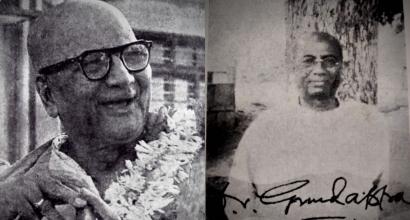
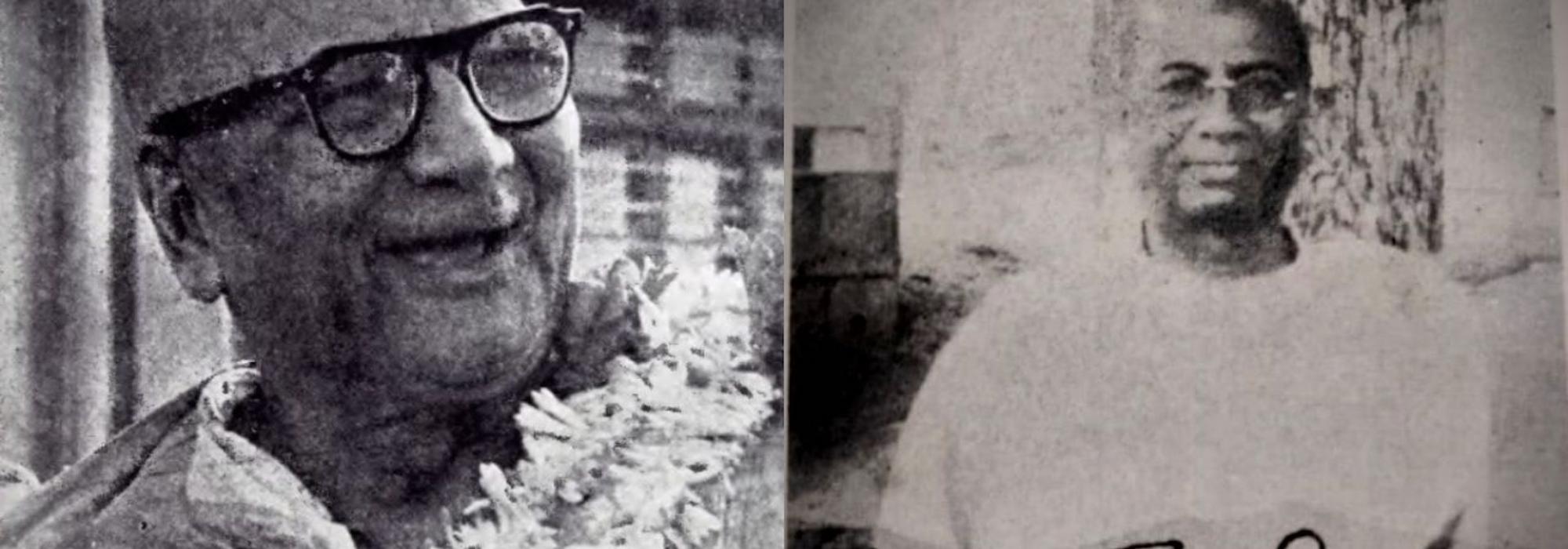
Let us look at a few instances that illustrate these traits.
The self-effacing DVG protested against having a special issue of a literary magazine dedicated to him and against a book written about him (Masti Venkatesha Iyengar: 27.5.1950, V Sitaramiah: 25.4.1973). When V Sitaramiah wished to celebrate DVG’s eightieth birthday, he made a mockery of the proposal by suggesting eight hilarious activities (23.12.1968). When he was pressed into accepting an Hon. D. Litt. from the University of Mysore, he remarked:
“The University has, if I may speak of it, adopted a vagrant into the family today … My main occupation for over fifty years has been journalism; and journalism is, in my understanding, as distinct from literature as road-gravel is from a mountain or a puddle from a lake. The journalist handles things in their passing phases – fragmentary and momentary. Literature concerns itself with things of universal significance – entire and unaging. Hence my diffidence in receiving what belongs to literature. I take it that the University intends to encourage a desirable aspiration in a struggler. I pray my instance may not come to be taken as a precedent for any case of insufficiency of correspondence between the label on the bottle and the contents within.” (25.11.1961)
From the letters DVG wrote to his daughter, Smt. Meenakshi (Thanga), we learn that several eminent people used to call on him: C Rajagopalachari; R R Diwakar; K A Balasubrahmanya Iyer; Robert North, the editor of Pacific Spectator and the editor of The Tribune. We also learn that DVG used to visit M Visvesvaraya and Mirza Ismail quite frequently. This section records an important fact that DVG was a member of the General Council of Sahitya Akademi when the body was first convened (22.2.1954).
As much as DVG hobnobbed with eminent people, he took joy in the small pleasures of life. He has written about a heartwarming incident in a letter to his daughter:
“… When I was in front of the radio, about 8.30, barber Vasanthaiya came and said I must go near his shop (near Gopi Restaurant) and listen to the ಮೇಳ [meḻa] by some South Indian pipers there – in celebration of Tyagaraja Day. I duly went there at once and heard a very good ಓಲಗ [olaga] performance – till about 9.30. Then the procession started and turned into the Nagasandra Road. There in front of our house the pipers stood and piped away till nearly 11 p.m. … I sent Chandru to the bazar and got a few garlands, and put a garland around the neck of each of the two good pipers and the three vigorous drummers. Weren’t they all pleased? I complimented them on their learning and skill. You should have seen their faces to realise how they valued my appreciation! They felt glad, and I am glad I made them feel glad.” (Smt. Meenakshi: 9.1.1953)
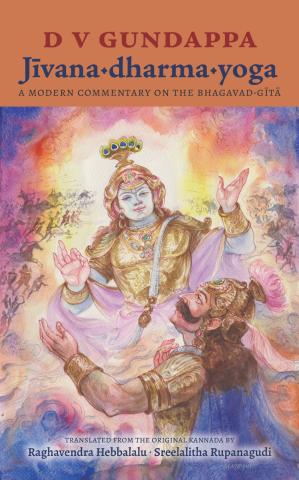
The letters offer us a glimpse of DVG’s literary activities as well. Recorded here are important details about the preparative stages of his journals and works such as The Karnataka, Karṇāṭaka Jana-jīvana mattu Artha-sādhaka Patrikè, Jīvana-dharma-yoga, Śṛṃgāra-maṃgaḻam and Bhārata-bhū-vandanam (A R Banerji: 25.9.1923, S R Ramaswamy: 28.8.1964, G Varadaraja Rao: 2.2.1972, G P Rajaratnam: 1975). We have here DVG’s English renderings of the title Maṃku-timmana Kagga: A Dull Bumpkin’s Rigmarole, A Fuddled Fool’s Farrago (V Sitaramiah: 23.11.1965) and A Foggy Fool’s Farrago (N Raghunathan: 9.11.1965).
We have examples galore to understand the mind of the man:
“…You ask whether I am conscious of any mission. What a question to ask! You know nothing of me if you do not know that I have always viewed life as a supreme ‘Leela’ – sport if you please. As such, how could I fall into the error of making a missionary of myself? It is only people wanting in modesty that conceive great ideas of themselves and their so-called mission here.” (N Narasimhamurthy: 22.3.1923)
*
“[…] There are a good many in our day who are ready to serve the country with their speech. But I am looking for those who would serve her by their thought, that is by applying their minds incessantly to the sifting of opinion and argument without fear or bias. ‘Search with many sighs’ – this, I have read, was the motto of Pascal and great is the need today for man with a similar passion for intellectual penance – making, so to say, Jnanam Tapah as the Upanishads say.” (Gorur Srinivasa Murthy: 9.5.1923)
*
“Once upon a time I could flatter myself on my familiarity with the Bhagavad Gita. But now I dread to touch it … For my difficulty is not about understanding the word, but about absorbing the morality.” (Mirza Ismail)
DVG was not just sombre and dignified but also playful and quick-witted as the situation demanded. In a letter written to his associate B S Subbaraya he has carefully outlined the possible ways to carry an umbrella on one’s person – what’s more, he has even written sketches of these possibilities! (11.6.1961)
* * *
The letters in this volume have recorded little-known details of DVG’s personal life – how he was as a husband, father, grandfather and the head of a large family. Because he was preternaturally sensitive to the finer impulses of life, the letters he has written to his family members—particularly his wife—are soaked in tenderness. DVG lost his wife to a ghastly fire accident early in life (1924) but cherished her memory till the last. We see in these letters his reflections on bereavement and gratitude to those who helped him bear the loss and plough on (DVG’s Children: 8.3.1954). He used to dote over his daughters, take pride in his son’s achievements but warn him against self-aggrandizement, give them lessons in grammar (Smt. Meenakshi: 16.10.1952), share his joys and sorrows and generally take a genuine interest in everyone’s life. He wished to see his children read the best of world literature and to this end, suggested authors and sent them books regularly. He was particularly insistent on the Rāmāyaṇa and bought books to be read by not just his daughters, but also his sister-in-law, daughter-in-law and other relatives. He acted as the central exchange for the circulation of books (Smt. Meenakshi: 2.1.1954). We cannot but marvel at the time and mind-space that a person of his stature had to write letters to his grandchildren, remember the names of their friends, give them thoughtful gifts and entertain them with funny one-liners and poems.
* * *
Some of the letters in this volume give us first-hand details of DVG’s involvement in politics and public life. From the letters written to Mirza Ismail when he was the Dewan of Mysore, we gather that DVG used to give frequent inputs to run the State. His advice was sought even after Independence, as evidenced from his letter to K C Reddy, the first Chief Minister of Karnataka (13.10.1947). One of the most important facts recorded here is the following: B R Ambedkar had read out an extract from DVG’s work on the Native States at the Second Round Table Conference (N Gopalaswami Ayyangar: January 1947). As a member of the Mysore Legislative Council, DVG argued in favour of Kannada as the administrative language and suggested measures to check religious conversion (The Secretary, Mysore Legislative Council: 17.12.1936).
When a respected friend expressed his wish to see DVG in the Constituent Assembly, the latter unequivocally remarked:
“I content to remain an observer in the outer court. I have the right to comment and advise from where I am, and that is enough for me. I am convinced that entering into any kind of competition for power or place of influence is an evil I should avoid.” (H N Kunzru: July 1946)
A paragraph from one of his letters to Mirza Ismail records his disenchantment with politics and his desire to withdraw from active public life:
“I have never looked for any prizes from any quarter, and do not want any – neither membership of the State Council, nor the State’s Deputyship in the Federal legislature, nor Speakership of the Legs. Council. My ambitions have never been in that direction. I have never aspired to the honours of leadership anywhere. I am aware of my limitations. My role is that of an humble student and I’m content with that … My wish is to give the rest of my life to the work of interpreting to my countrymen some of the things that I value in the great books I’ve read – in poetry and philosophy and politics. Shakespeare and the Ramayana and Plato are the voices that call me, and to them I would go in my freedom. Public life has made me sick. My soul is crying for peace. So have mercy and let me go out of public life.” (Mirza Ismail: 3.3.1938)
* * *
The letters addressed to littérateurs, inter alia, present an impressionistic chronicle of the Kannada literary scene during the Navodaya Era. We learn from these that DVG was sincere and spontaneous in appreciating the works of his fellow-writers. Not one given to dishing out empty praise, he unfailingly highlighted the qualities of the work for which it deserved praise. The result was nothing short of a masterclass in literary criticism. Here are a couple of examples picked at random:
“Your ವೈಶಾಖಿ [Vaiśākhi] should have been printed in sapphire and gold on sheets of silver … I read it in the night, and it made me take up your ಗೊಲ್ಗೊಥಾ [Golgotha] for reading again. May I say what I feel? I consider both these poems—true books of poetry—outstanding contributions to our literature—the themes of such deep and lasting inspiration, the treatment so classical in power and clarity. Here is compression of emotion and thought, and economy of words which makes for power, that is the characteristic of true literature. And you have combined freshness of phrase and familiarity of phrase with such skill and mastery that the reader is kept interested and eager and not for a moment made to feel that he is being addressed by a superior person coming from a strange country. Noble topics nobly dealt with!” (M Govinda Pai: 10.7.1947)
*
“What a deeply moving story is this one that you have now written!
I have heard Sir Walter Scott was a favourite of your fastidious teacher Tait. I feel Scott would have been proud to see in himself the author of a work like ಚೆನ್ನಬಸವನಾಯಕ [Cènna-basava-nāyaka].
The atmosphere of those troubled and exciting times has come off to a T, – so convincingly. And your characters are so animated and compelling in their speech and behaviour. Mastery of style has always been yours. May I say you have achieved here a marvel of economy and adequacy of phrase? The dialect of Malnad and the idiom of Court and Council have been so perfectly brought out. Your pictures are vivid and full of life, and you have informed them with a philosophy so sustaining and satisfying … Who will not feel grateful for such a gift?” (Masti Venkatesha Iyengar: 30.12.1949)
To order a copy, contact: +91 74836 81708 (Sahitya Bharati).
To be continued..