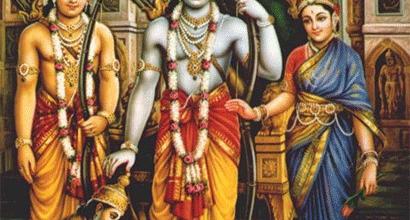
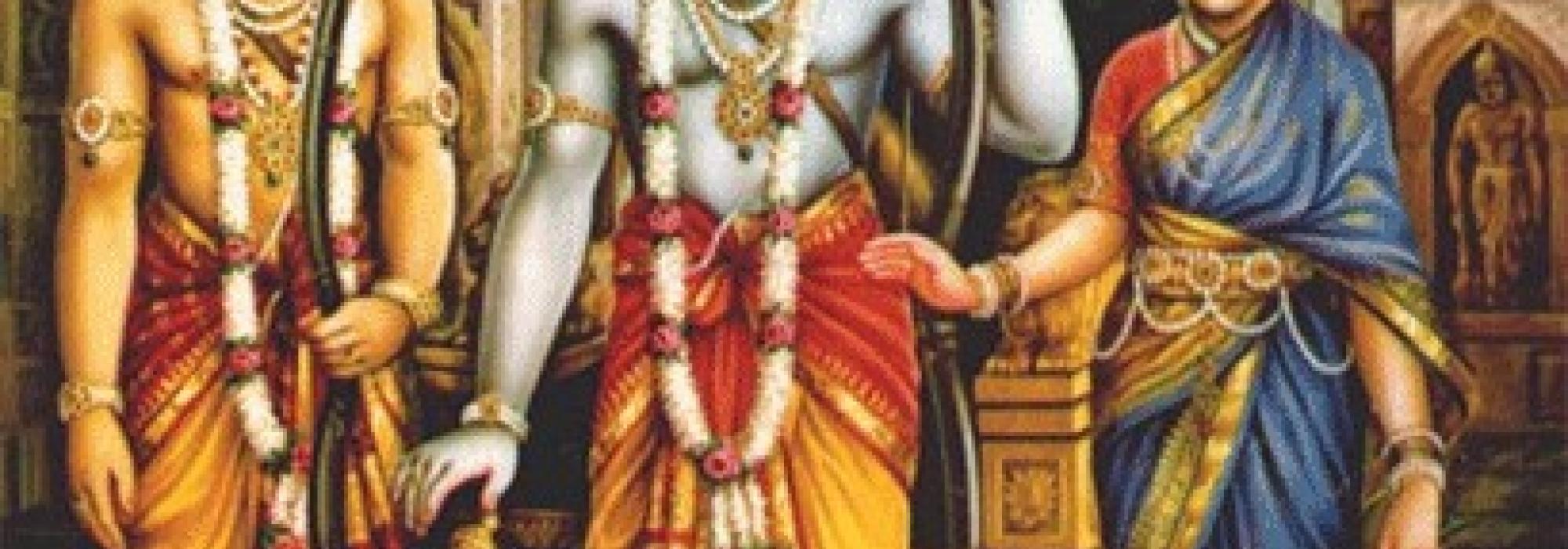
Padma then goes on to the line tau pituḥ vācā pañcavaṭi-vane viharataḥ to continue the story and in the process, she indicates how Rāma, Sītā, and Lakṣmaṇa were ferried across the River Gaṅgā – she uses a special movement of the feet while she rows (the invisible boat) with her hands; it gives the viewer the illusion of a real boat moving across the stage. The movement is also along the diagonal of the stage, giving us the three-dimensional feel. She even depicts the boat stopping with a mild jerk at the banks of the river and each getting off with different mannerisms. Padma distinctly characterises Rāma, Sītā, and Lakṣmaṇa (while on the boat and also as they walk in the forest). Rāma walks ahead into the forest – firm, serene and gentle; Sītā, naïve, innocent, happy, and curious, walks behind him looking all around and feeling pleasantly surprised and awestruck at every aspect of the forest. Lakṣmaṇa is ever alert, vigilant, and watchful and follows the couple watching out for danger. Just by going around on the stage once[1], she quickly changes into the three characters one after the other, three times; as she walks, Sītā once looks at Rāma, then at the surroundings, and then at Lakṣmaṇa – her innocence and excitement come out effectively on her face. Rāma and Sītā then enter their hut (while Lakṣmaṇa stands guard!). Connoisseurs can recognise the character merely by looking at Padma’s face – the sattva is so immense that even without looking at the gesture in the hands, one can recognise if she is presenting Rāma, Sītā, or Lakṣmaṇa.
Once, as Sītā is plucking flowers, she notices a golden object at a distance and then, as it comes closer, realises that it is a deer – Padma establishes that only its golden colour is visible for a while and its form becomes clear only when it comes closer. In fact, through this, she also suggests the distance traversed by the deer. We see only the colour of an object when it is far away and we see its actual form only when it comes closer. Out of her curiosity and excitement, she follows the deer with a bunch of grass in her hand. As the deer vanishes, Sītā is upset and asks Rāma to fetch the golden deer for her. Padma spontaneously improvises and her Rāma tells Sītā that the deer’s eye is no match for hers; within a couple of seconds Sītā, whose face radiates naivety, has tears in her eyes; Rāma finally agrees to bring her the deer and chases after it with a bait in his hand. The deer, which is indicated by Padma through Hariṇa-pluta karaṇa is shot by Rāma, turns into a rākṣasa, and screams – Padma even shows that the scream traces the same path as the route traversed by the deer (by going in a circle on the stage, but in the reverse direction) and falls on Sītā’s ears; Sītā upon hearing the illusionary cry of Rāma (rākṣasa’s cry), pleads to Lakṣmaṇa to go to Rāma’s help. When Lakṣmaṇa brushes it aside as deception, the vyabhicāri-bhāvas of Sītā are innumerable and revolve around the sthāyi-bhāvas of śoka and bhaya – she has shades of anxiety and irritation which finally turn into anger; she admonishes Lakṣmaṇa. (In fact, it needs to be noted that the lasting sthāyi-bhāvas of Sītā is love, i.e., rati towards Rāma, which manifests as śoka and bhaya out of her concern for him). Helpless, Lakṣmaṇa finally agrees to leave to search for Rāma and draws the lakṣmaṇa-rekhā as per the popular version of the epic. As he hurries into the forest, Padma depicts Lakṣmaṇa as though looking back every moment, anxious about Sītā’s safety.
At this juncture, the musical rendition of the verse goes on to the next phrase – tām-āharad-rāvaṇaḥ. Padma depicts the ten heads, twenty eyes, and twenty arms of Rāvaṇa; as he walks around the stage, she shows how each of his twenty arms moves in various directions; his gait is filled with arrogance and superiority complex. The music also works as vyañjaka-sāmagri to enhance the demonic nature of Rāvaṇa. Padma then depicts Rāvaṇa pulling in his twenty arms and ten heads and assuming the form of a saṃnyāsī – the expression on Padma’s face reveals that he is not a real saṃnyāsī but has come there with an ulterior motive. She depicts him as having a long beard, with a rudrākṣa-mālā around his neck and arms, carrying a kamaṇḍalu. Padma helps us imagine the āhārya of the kapaṭa-saṃnyāsī superimposed upon her dance costume. She also shows that while the external appearance of Rāvaṇa has changed, his gait has remained unchanged; thereby, she suggests that even if a person’s external appearance is masked, his innate character invariably gets reflected through his mannerisms and speech. He walks with his demonic gait and encounters lakṣmaṇa-rekhā – the fiery line. In a moment’s time, his ego seems to be hurt because he was unable to cross a mere line. Padma’s Rāvaṇa, in the disguise, of saṃnyāsī demands for alms (and does not beg!) and instructs Sītā to cross over the line and offer it to him. As she heads towards him, Rāvaṇa momentarily forgets that he is in disguise and starts admiring her beauty with his eyes and mouth wide open – he almost undergoes the sāttvika-bhāva of stambhana; Padma thereby suggests that even the vilest of beings, when they see untainted Beauty, they overcome the limitations of their personality at least momentarily; in other words, ego dissolves and the opaque personality makes way for the experience of Bliss, which is akin to Rasānanda. However, once he comes out of that state, pride and lust overpower him. He looks at Sītā from her feet up until her head and his lustful desire (dṛṣṭi-maithuna) becomes evident on his face. After a few seconds, with a jerk, he becomes aware of himself and gets back to the kapaṭa-saṃnyāsī’s mental state. Through this sequence, Padma indicates Rāvaṇa’s personality at three levels; first, he can relish Beauty and experience Bliss – his Self transcends his external attributes; second, he is a proud, arrogant, lustful, crooked, and possessive rākṣasa; third, he is in the disguise of a saṃnyāsī. Padma portrays each of these layers of his character!
Sītā who has mixed emotions of respect, fear, and inhibition crosses over the line with her head bent down and offers bhikṣā; even as her head is bent down, the evil rākṣasa catches her tresses and flies into the air in no time! Padma, as the narrator Yaśodā, shows through her eyes the heights to which Rāvaṇa took her away, at great speeds. The next moment the baby Kṛṣṇa (who is, in reality, no different from Rāma) gets up alarmed, anxiously asking – saumitre! kva dhanur-dhanur-dhanuḥ; the musician repeats the word dhanur-dhanur many times to give the effect of anxiety. And moreover, the child would not have uttered it only thrice as captured in the poem; in reality, the child would have demanded its bow multiple times. The poet and Padma suggest that the vipralabha-śṛṅgāra experienced by Śrī-rāma was so intense that it gets carried forward to the next avatāra as well.
With a prayer seeking the blessings of such dhārmically rageful words of Kṛṣṇa, Padma (and the poet Līlāśuka) establishes the non-difference between Śrī-rāma and Śrī-kṛṣṇa. The primordial child Kṛṣṇa himself got mesmerised and carried away by his own story in the form of Śrī-rāma – when such is the case, it is needless to say how humans will get enraptured by the story of Rāma (and the presentation of Padma!).
To be continued
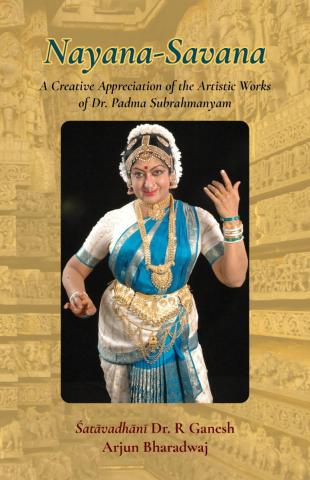
The current article is an extract from the book Nayana-Savana, authored by Shatavadhani Dr R. Ganesh and Arjun Bharadwaj.
[1] Going around in a circle on the stage is also a nāṭya-dharmī technique of the Nāṭyaśāstra to suggest the change of scene, which is creatively adapted by Padma in various presentations.