The ekārtha presentation Rāmāya Tubhyaṃ Namaḥ by Dr. Padma Subrahmanyam has captured the imagination of three generations of audience and has touched the hearts of the lay and the learned alike. As typical to an ekārtha presentation, Padma presents several episodes and characters, and thereby, sketches the physical, emotional, and spiritual journey – ayana – of Rāma. In the Indian tradition, Rāma is held as one of the highest ideals of a son, brother, husband, friend, king, and lord. His name suggests that he causes pleasure to everyone around him – ramayati iti rāmaḥ. Therefore, it is befitting that Padma has chosen a theme based on the Rāmāyaṇa and has chosen the best aspects from various regional retellings of the epic. With her choice of segments from various literary works, Padma has ensured that the vision of the seer-poet Vālmīki is never compromised. It also helps the audience realize the way in which Rāma has been adored and worshipped across timelines, throughout India. He has unified the hearts of all poets and artists across ages.[1]
The presentation starts with the rendition of the verse yaṃ brahmā-varuṇendra-rudra-marutaḥ stunvanti divyaiḥ stavaiḥ, that concludes with the line yasyāntaṃ na viduḥ surā sura-gaṇāḥ devāya tasmai namaḥ. The verse is meaningful in the context of the presentation, as the greatness of Śrī-rāma (or even Śrī-kṛṣna or Bhagavān Śiva for that matter) cannot be comprehended even by the devas, let alone mere mortals. The infinite, formless, and primordial Being takes the finite form of Śrī-rāma. The verse appears like a humble submission by the artist who intends to convey that she is portraying the character of Rāma to the extent she has realized and internalized. Next, the verse tunbangaḻ vandiṭṭālum tunukkuramāṭṭān is recited, which indicates the very nature of Śrī-rāma – the Divine who is untainted by sorrows and unaffected by happiness. The opening verses in Sanskrit and Tamil are set to Yamunā-kalyāṇī and Mohana rāgas which bring to our mind Śrī-kṛṣṇa and Śrī-rāma – in fact, the first segment of the production depicts the summary of the Rāmāyaṇa as narrated by mother Yaśodā to the baby Kṛṣṇa.
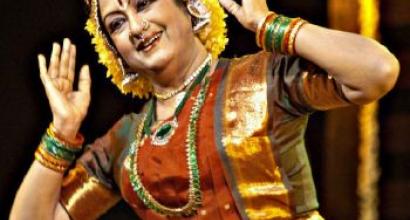
Dr. Padma Subrahmanyam enters the stage with flowers in her hands; after performing namaskāra to the raṅgapīṭha, she performs salutations to the devas, ṛṣis/gurus, and the humans – she uses the traditional convention – namaskāra to the devas is performed with añjali-hasta held above the head, to the ṛṣis/gurus at the face, and to the common men (and rasikas) at the chest (near the heart). As a part of the brief pūrva-raṅga, Padma performs nṛtta filled with grace. Padma, in her nṛtta for the Toḍaya Maṅgalam effortlessly brings in the variations of the pārśva, giving rise to the seamless switching between sama-bhaṅga, dvi-bhaṅga, and tri-bhaṅga; she brings these with simple aḍavu techniques. The all-inclusive mārga of the Nāṭyaśāstra, is after all, not averse to deśī movements. In Padma’s nṛtta, we invariably see the fluid movements of the mārga blending into the largely geometric movements of deśī – the two, which are usually thought of as contrasts to each other, find their fulfilment in Padma’s art. It is akin to the co-existence of Sanskrit with various Prakrits in classical Indian plays. Padma’s mastery over all fundamental aspects of aṅga and upāṅga and her control over every muscle in her body makes every movement appealing and captivating. For Padma, Rasa and sauṣṭava are the governing parameters for every movement and enactment. Soon after the nṛtta, Padma assumes the classical pose of Śrī-rāma with immense sattva – the pose exactly corresponds to those found in sculptures across the country and across timelines. Padma transforms herself completely into Rāma in no time; she stands in a tribhaṅga with her right hand indicating the arrow and the left indicating the bow. The opening nṛtta sets the mood for the entire production – it is akin to the playing of śruti or sa-pa-sa at the beginning of a music concert.
The following verse is recited in the Rāga Revati as though to provide the production with a vedic backdrop. The verse also provides the title for the production – Rāmāya Tubhyaṃ Namaḥ.
rāmo rakṣatu māṃ carācara-gurū rāmaṃ namasyāmyahaṃ
rāmeṇāmara-śatravo vinihatāḥ rāmāya tasmai namaḥ|
rāmād-eva samutthitaṃ jagad-idaṃ rāmasya dāso'smyahaṃ
rāme bhaktir-acañcalāstu bhagavan! he rāma! tubhyaṃ namaḥ ||
Connoisseurs of Sanskrit literature will immediately recognise that the verse uses the word Rāma in all the seven vibhaktis (in addition to the sambodhana-prathamā-vibhakti). It at once helps the Sanskrit student understand the application of the Rāma-śabda, which is one of the first lessons in Sanskrit and also gives us an idea about the personality of Śrī-rāma. This also suggests the various activities (kriyās) associated with Rāma, thereby pointing to the path traversed (ayana) by him; thus, it is the Rāmāyaṇa, once again!
Padma fills her padārthābhinaya with so much of sattva that it is much more than mere translation of lyrics into gestures. For example, for the phrase rāmasya dāso'symaham, she attains the posture of Śrī-rāma and quickly changes into that of a dāsa, with her head and back bowed down, legs crossed and hand held in submission; this quick transition from the lord to the dāsa is remarkable. Similarly, for the phrase bhaktir-acañcalāstu, she depicts intense concentration, a quick deviation, and indicates that such diversions should be avoided. She adapts the first karaṇa – Talapuṣpapuṭa to the phrase rāmāya tubhyaṃ namaḥ; she actually holds flowers in her palms and brings the effect of the movement through her legs, hip, neck, and eyes with subtle recakas; she moves to the corner of the stage and offers the flowers to the image of the Divine.
To be continued
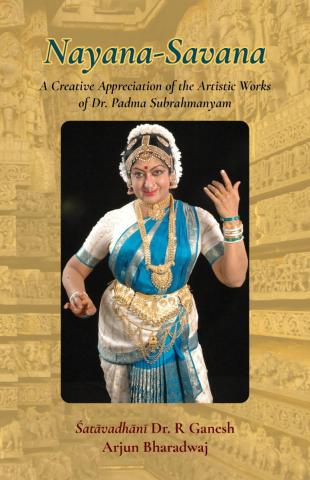
The current article is an extract from the book Nayana-Savana, authored by Shatavadhani Dr R. Ganesh and Arjun Bharadwaj.
[1] At this juncture, the words of the pan-Indian Kannada novelist Padma Bhushan Dr. S.L. Bhyrappa come to mind. He had once said that any great Indian novelist (and artist) is invariably tempted to write and portray episodes from the Rāmāyaṇa and the Mahābhārata, the immortal epics of the world. If he is not tempted, he is not an Indian and cannot be a great novelist. True to the words of the literary giant, Padma Bhushan Dr. Padma Subrahmanyam has not only presented full-fledged bhāṇikas connected with Rāma and Kṛṣṇa but has also presented innumerable short-length pieces on the themes.