Banish to the Forest
Rāma and Sītā might have spent only a few days in peace in the palace, when the lightning bolt of banishment to the forest strikes them. While the lightning bolt would have disturbed a mortal, Rāma, whose character embodies sthita-prajñatva is unperturbed.
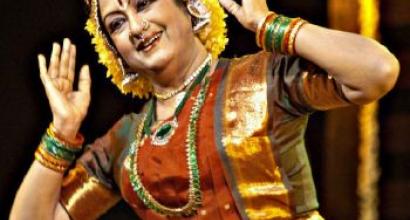
Padma uses special movements to represent Rāma riding a chariot; even the simplest act of alighting from the chariot is also indicated using a loka-dharmī based movement. Rāma happily goes to meet his father, and true to his character (as also indicated in the original epic), bows down at Daśaratha’s feet; however, the father does not even look at his son. Rāma spots Kaikeyī there; Padma establishes the character of Kaikeyī through the display of ego, pride and arrogance on her face, mixed with contempt for Rāma.
Rāma variously pleads Kaikeyī to tell him his father’s intent. He says –
tad-brūhi vacanaṃ devi! rājño yad-abhikāṅkṣitam|
kariṣye pratijāne ca rāmo dvir-nābhibhāṣate||
He promises to Kaikeyī that he will not walk back upon his words, once promised
Kaikeyī with a menacing demeanour, says –
sapta sapta ca varṣāṇi daṇḍakāraṇyam-āśritaḥ|
abhiṣekam-imaṃ tyaktvā jaṭājina-dharo vasa||
The Rāga Ṣaṇmukhapriya is employed for the rendition of the above verse; it especially comes in handy because it is a sampūrṇa rāga containing all seven svaras in its ārohaṇa and avarohaṇa. The seven svaras are rendered in the ārohaṇa for the first occurrence of the word sapta and in the avarohaṇa for its second occurrence; this sums up to fourteen. This is a very good instance of using music to emphasize an idea; music becomes vyañjaka to suggest an idea here.
Kaikeyī says –
bharataḥ kosala-pure praśāstu vasudhām-imām|
nānā-ratna samākīrṇāṃ sa-vāji-ratha-kuñjarām||
Through the words and actions of Kaikeyī, Padma shows how she intends Bharata to rule the kingdom and enjoy the pleasures of innumerable gems, horses, elephants, and chariots – the tāla, svara-sañcāra, and movements are tuned to indicate horses (Janita cārī), elephants (Gaja-krīḍitakam with recita hands), and chariots. Kaikeyī emphasizes – daṇḍakāraṇyam-āśritaḥ with firmness in her voice and mannerisms (indicated through music). However, the next moment, she feels ashamed and guilty for what she has done, turns her face away, and is anxious to see Rāma’s reaction.
Next, the following verse is rendered in Rāga Yamunā-kalyāṇī
itīva tasyāṃ paruṣaṃ vadantyāṃ na caiva rāmaḥ praviveśa śokam|
pravivyathe cāpi mahānubhāvo rājā tu putra-vyasanābhitaptaḥ||
Padma as Kaikeyī depicts her feeling she has uttered āsuric words (paruṣaṃ vadantyāṃ); a troubled Kaikeyī, out of fear, once looks at her dejected husband and then at Rāma and is surprised to see that Rāma is not perturbed at all! (na caiva rāmaḥ praviveśa śokam!)
At this juncture, Padma aptly brings in the following verse from the Bhagavad-gītā –
duḥkheṣvanudvigna-manāḥ sukheṣu vigata-spṛhaḥ|
vīta-rāga-bhaya-krodhaḥ sthitadhīr-munir-ucyate||
Rāma was indeed unperturbed when he faced a situation that could have caused immense pleasure (sukha) and did not lose his stability even when he encountered the possibility of (duḥkha). He retained his calm demeanour when he got to know that he would be coronated and did not let it go even when he was asked to go to the forest. Rāma had no material attachments and anger about anybody (including Kaikeyī and Daśaratha). He is indeed a muni – and like a muni, goes to the Daṇḍaka forest. The sequence enacted by Padma suggests that Kṛṣṇa’s preaching in the Bhagavad-gītā was, in fact, followed by him in various avatāras including the Rāmāvatāra.[1]
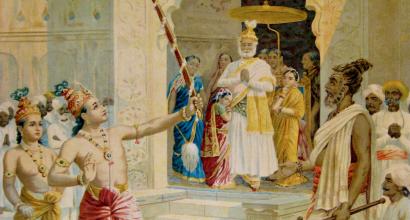
Rāma happily agrees, saying vijane vane vatsyāmi, if that will make his father happy; He also says na hyato dharma-caraṇaṃ kiñcid-asti mahattaram (There is nothing greater than following dharma). Rāma also says viddhi māmṛṣibhis-tulyaṃ kevalaṃ dharmamāsthitam – consider me as a ṛṣi, who is always devoted to dharma. He also indicates that fourteen years in nothing – Padma counts fourteen on her fingers as though to suggest that the years will pass-by quickly, as quickly as one can count them on fingers. With a pleasant smile on his face throughout, Padma’s Rāma goes in a pradakṣiṇa around Kaikeyī and touches her feet respectfully (as documented in the original epic as well).
Padma also shows through her āṅgikābhinaya that Rāma seeks Kaikeyī’s permission to inform Sītā; he asks Kaikeyī to send messengers to quickly inform and fetch her son Bharata and requests her to take care of Daśaratha.This too is from the original epic and Padma presents the summary of the verses through her abhinaya.
Shameless Śūrpaṇakhā
Though Rāma, Sītā, and Lakṣmaṇa went to the forest, their peaceful life was interrupted by quite a few incidents. One such is the entry of the lustful Śūrpaṇakhā, which changes the direction of the entire story. While the sister desired an already married man, she instigated her brother Rāvaṇa to desire the wife! Both represent adhārmic rati and in fact, are examples for śṛṅgārābhāsa. Moreover, the sister and the brother desired to possess only one person in the couple, which led to their deaths. Personalities like Hanūmān and Lakṣmaṇa who embraced both Rāma and Sītā reached sublime heights.
This segment in Padma’s presentation portrays Śūrpaṇakhā. Padma has chosen verses from the bhakta-kavi Ezhuthachan’s Bhāṣā-rāmāyaṇam composed in Malayalam. The lines go kāmarūpiṇi kaṇḍāḻ kāmini vimohini pādaṃgaḻ.
Śūrpanakhā enters the stage with a demonic gait – she spots attractive footprints that bear the marks of pañkaja (lotus), dhvaja (flag), kuliśa, and añkuśa. She wonders what could be the beauty of the face of the person who leaves behind such impressive footprints. She is overcome with desire – the Rāga Ārabhi used also suggests sammohana – lustful infatuation; she follows the footprints, goes around the stage and finally arrives at Rāma’s āśrama. In several productions, Padma uses the stage convention of going around in a circle on the stage to indicate a change of scene.
Śūrpaṇakhā, who is afflicted by mīnaketana-bāṇa (arrows of the cupid) is disappointed to see that Rāma is married and is enjoying the company of Sītā. She decides to take the form of an attractive lady. Padma depicts the manner in which Śūrpaṇakhā decks herself up, constantly peeping at Sītā, and making sure that she looks more charming than her. The rākṣasī only tries to compete with Sītā in her external appearance and does not realize her internal sattva; the rākṣasa-guṇa, which cannot look or think beyond the material and the physical, amply gets reflected in Śūrpanakhā’s character. She even gives up her demonic laughter and dons mandahāsa – soft and gentle smile. However, Padma makes sure to show that her demonic nature is visible amidst her pretentious mandahāsa. She is only wearing a benign mask but her real nature is not actually suppressed. Padma’s impeccable ability of first entering the character of the rākṣasī and then ‘disguising’ herself as a noble and beautiful woman is astounding. Her transformation into characters works at several layers.
She asks Rāma who he is and whose son he is, and introduces herself as the sister of rākṣaseśvara Rāvaṇa; she also says that she is Śūrpaṇakhā (Padma depicts the meaning of name – having long, sharp nails) but is kāma-rūpiṇī – can take any form she likes. This comically contrasts with the description of her real form – though in reality, she has long and sharp nails, she can take any form to impress anyone! This also suggests that she is not faithful to one form or personality – as per her whims and fancies, she can take whatever form she wishes. Rāma introduces himself and also tells about Sītā and Lakṣmaṇa. For Śūrpaṇakhā’s reply, the music switches to a folk tune based on Rāga Punnāgavarālī; she requests Rāma to marry her and Rāma tells her that he is a eka-patnī-vratastha. Sītā is scared and pulls Rāma’s arm, asking him not to heed to her requests. Padma makes her Rāma say that it is difficult to be a co-wife to an already married man; to the line sapatniyoḍa duḥkhaṃ yatrayo kaṣṭaṃ kaṣṭaṃ, he depicts how wives will quarrel and ridicule each other!
He asks Śūrpaṇakhā to approach his brother Lakṣmaṇa by saying – Lakṣmaṇan mama bhrātā sundaran manoharan and he is maṅgala-śīlan. When she requests him to be her consort, Lakṣmaṇa sends her away saying that he is Rāma’s dāsa and if she marries him, she will need to be a dāsī of a dāsa; he sends her back to Rāma, who in turn refuses and sends her to Lakṣmaṇa. Being tossed between the brothers a few times, Śūrpaṇakhā undergoes āśā-bhaṅga – heartbreak; her love slowly turns into anger. Padma shows that Śūrpaṇakhā partially removes her beautiful form and tries display her rage towards Lakṣmaṇa but is spontaneously overcome with love. She tries hard to suppress her āsuric nature, but cannot fake her appearance or emotion for long. Unable to control her anger, she turns into her demonic form with her body as hard as rock, teeth protruding, and nails sharp and long, true to her name. She considers Sītā as the real impediment in procuring Rāma and tries to attack her. Lakṣmaṇa intervenes, chopping off her nose, ears, and breasts. She gets so angry that the niśācarī, i.e., the rākṣasī looks like Kālarātri – the fearsome Goddess. She looks at her reflection in a river, is enraged, and throws sand/dust at the brothers cruelly cursing them – these improvisations are made by Padma and do not occur in the lyrics of the song or other poems related to the episode. This again is an instance of her āsuric nature – being bothered about her external appearance and being attracted by the external appearance of men. She declares that her rākṣasa brothers will soon come, crush the three – Rāma, Sītā, and Lakṣmaṇa to death and feast upon them. She again throws mud at them and goes away in pain. The transition of Śūrpaṇakhā’s desire into anger and finally into sorrow is presented in an unparalleled manner by Padma; it reminds us of the verse from the Bhagavad-gītā – kāmāt krodho'bhijāyate, krodhād-bhavati sammohaḥ ... buddhi-nāśāt praṇaśyati. Śūrpaṇakhā, after all, got destroyed because of her misplaced kāma and so did her brother and his men.
To be continued
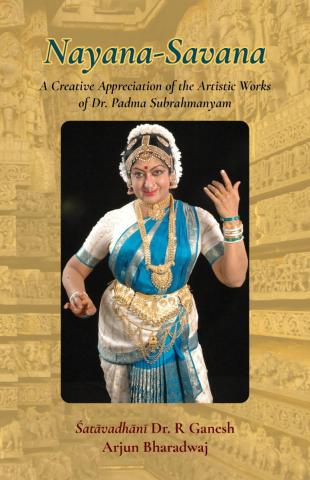
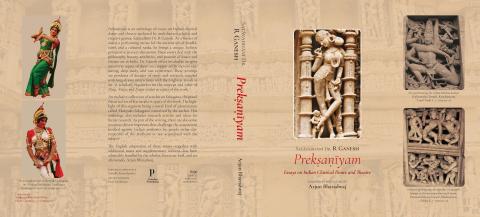
The current article is an extract from the book Nayana-Savana, authored by Shatavadhani Dr R. Ganesh and Arjun Bharadwaj.
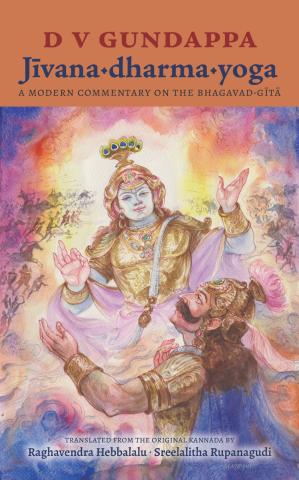
[1] This is reminiscent of Dr. D.V. Gundappa’s Bhagavadgītā-rāmakathā-samanvaya – his masterly commentary on the concordance of the teachings of the Bhagavad-gītā with the life and character of Śrī-rāma. In his Jīvana-dharma-yoga, he says
gītā-tattvāvabodhārthaṃ śrī-rama-caritaṃ smaret|
pūrvāvatāra-cāritrya vyākhyā kṛṣṇoktireva hi||
To understand the philosophy of the Gītā, recollect the life and deeds of Śrī-rāma; Śrī-kṛṣṇa, through the Bhagavad-gītā, provided a commentary to his own deeds that he had performed in the previous avatāra.