Āścarya-cūḍāmaṇi
Śakti-bhadra, who belongs to the Malabar region, is the author of Āścarya-cūḍāmaṇi. The play in seven acts contains the story of the Rāmāyaṇa, starting from Śūrpaṇakhā’s entry up until Rāma leaving Laṅkā to return home.
Rāma, with his valour, clears Janasthāna of rākṣasas; the sages who are pleased with him gift him āścarya-cūḍāmaṇi, adbhutāṅgulīyaka, and a kavaca. The āścarya-cūḍāmaṇi – a magical crest jewel – is worn by Sītā, the adbhutāṅgulīyaka – the prodigious ring – by Rāma, and the kavaca – armour – by Lakṣmaṇa. They had the power to reveal the identity of the rākṣasas by a mere contact, if they came in disguise.
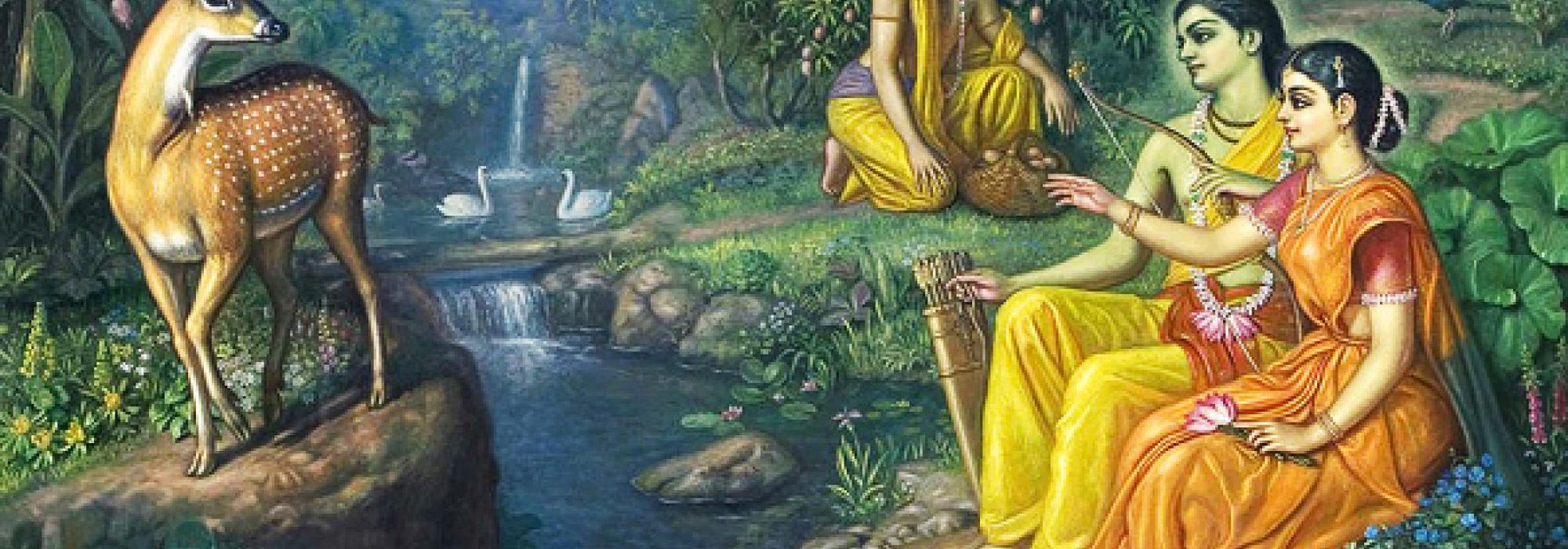
Śūrpaṇakha, who was punished by Lakṣmaṇa, instigates Rāvaṇa. Rāma and Lakṣmaṇa are separated for a moment because of the golden deer. Rāvaṇa comes in the disguise of Rāma to Sītā’s hermitage, and his charioteer in the guise of Lakṣmaṇa. Sītā is duped by their masked identities. Rāvaṇa and his charioteer carry her away on their chariot. Śūrpaṇakhā disguises herself as Sītā and goes to Rāma; Mārīca hoodwinks Lakṣmaṇa by going to him in the guise of Rāma. However, as Rāvaṇa and Mārīca come in contact with the cūḍāmaṇi and aṅgulīyaka, respectively, their identity is revealed. It is because of these very objects that Rāma and Lakṣmaṇa discover that Hanumān is not a masquerading rākṣasa and that Rāma is truly Rāma. In Laṅkā, Sītā comes fully decked to see Rāma, but he is shocked and disappointed. Nārada appears there and tells Rāma that with the blessings of Ahalyā, Sītā was automatically decked with ornaments as soon as she saw her beloved; he also clarifies that in the absence of Rāma, Sītā was in a state of pain. Finally, the sage sees them off to Ayodhyā.
This is a rather small play among those based on the Rāmāyaṇa; the playwright seems to have written this with quite some awareness about the practical staging of the play. It has only about a hundred and eighty-nine verses, and the language is lucid and simple. The poet has displayed great skill in abridging the story; his characters brim with life. Their speech is simple, but profound. Though there are some magical elements, the play resembles Bhāsa’s dramas more and does not tax our minds like Mahāvīracarita and such other plays. Though the poet intends to bring both vīra- and adbhuta-rasas, the latter dominates over the former. Rāma is explicitly mentioned as an avatāra of Bhagavān Viṣṇu.
Anargha-rāghava
Among the various works that the poet-playwright Murāri is supposed to have composed, we have been able to lay our hands only on the play Anargha-rāghava. We don’t know much about when and where he lived. It is quite possible that he lived in the period after Bhavabhūti and before Ratnākara (9th Century CE) in the city of Māhiṣmati. He belonged to the Maudgalya gotra; his parents were Bhaṭṭa-vardhamāna and Tantumatī. He calls himself Bāla-vālmīki.
In the following verse, Murāri says how he is inspired to write a play based on the Rāmāyaṇa theme, though many have already written in the past –
यदि क्षुण्णं पूर्वैरिति जहति रामस्य चरितं
गुणैरेतावद्भिर्जगति पुनरन्यो जयति कः।
स्वमात्मानं तत्तद्गुणगरिमगम्भीरमधुर-
स्फुरद्वाग्ब्रह्माणः कथमुपकरिष्यन्ति कवयः॥ (1.9)
It is hard to say if he has Bhavabhūti or an earlier poet in his mind when he writes the above. There is some similarity in the prastāvanā of this play and those of Rājaśekhara. It is also likely that they were contemporaries of each other.
The Anargha-rāghava was staged during the yātrā of Puruṣottama by a person named ‘Sucarita’, who belongs to the central parts of the country. The play is in seven acts, and the following are the main incidents that take place–
- Viśvāmitra calls Rāma and Lakṣmaṇa;
- Tāṭakā-saṃhāra – vanquishing the rākṣasī Tāṭakā
- The breaking of Śiva’s bow; Śaulka, who had come to ask for Sītā’s hand in marriage to Rāvaṇa, reports to the latter, Rāma’s indomitable feat.
- Paraśurāma is defeated; Rāma and others resort to the forest
- Abduction of Sītā; Vālī is vanquished
- Vidyādharas report the killing of Rāvaṇa
- Rāma and others return to Ayodhyā in their vimāna; description of the path and the journey
In this play too, we see Mālyavanta conspiring against Rāma; it is not Śūrpaṇakhā who enters Mantharā’s mind, but Siddha-śabarī who does so; Mālyavanta is an expert at artha-śāstra; he is quite thoughtful in his actions. In the play, Rāma engages in a dhārmic fight with Vālī and kills him. The playwright has intelligently compressed the epic into a play. There are five hundred and sixty-seven verses in the play.
It has been popularly said that Murāri represents the ‘third stream/path.’ The statement probably points towards the profundity of his utterance, which he is proud of. His characters speak refined language and appear mature and scholarly. They are verbose in their speech and provided detailed descriptions on many instances; in the viṣkambhaka that appears before the second act, ten verses are employed by the poet to describe his characters. The playwright’s language is quite complex and is filled with rare and unique grammatical usages. For instance, he refers to Vālī as Vikarta-tanaya. Śiva’s bow is referred to as Kātyāyanī-kāmuka-kārmuka (Act 3, Verse 16). It is hard to find prasāda-guṇa in his writings; his language is pedantic at times. It is probably because of his language that he has become the favourite of the scholars.
The following verse brushes aside Bhavabhūti, who fades in comparison to him –
मुरारिपदचिन्तायां भवभूतेस्तु का कथा।
भवभूतिं परित्यज्य मुरारीमुररीकुरु॥
The commentator on the play, Harihara-dīkṣita, says the following –
ये शब्दशास्त्रनिष्णाताः ये शीलितनिघण्टवः।
तेषामेवाधिकारोस्य ग्रन्थस्य परिशीलने॥
To be continued ...
The current series of articles is an enlarged adaptation of Prof. A. R. Krishnasastri's Kannada treatise Saṃskṛta-nāṭaka. They are presented along with additional information and footnotes by Arjun Bharadwaj.