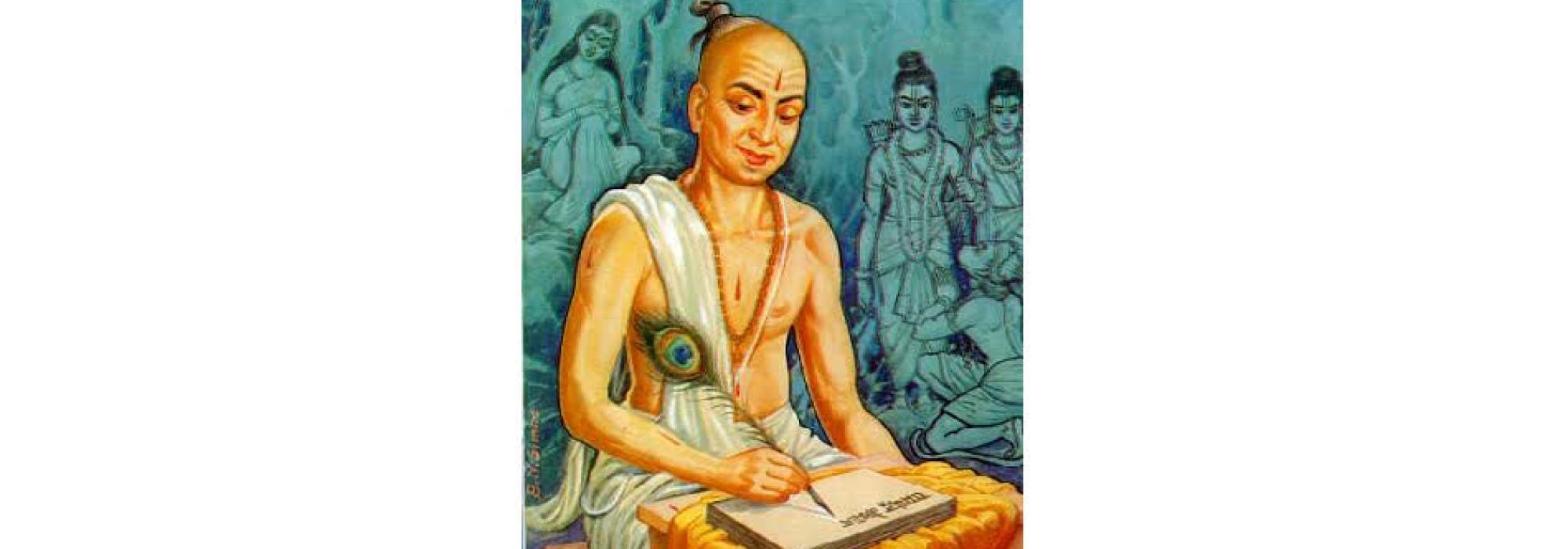
We may safely say that the Uttara-rāma-carita was the final product of Bhavabhūti’s talent; however, we are discussing the play here because its story is a continuation of the Mahāvīracarita. The following is the summary of its plot –
(Sītā is in her final stages of pregnancy; the elders of the family leave her in the care of Rāma and Lakṣmaṇa and are away to attend a yajña performed by Ṛṣyaśṛṅga)
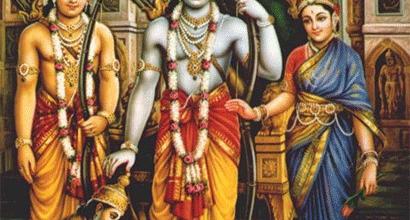
To help Sītā overcome her boredom, Rāma and Lakṣmaṇa show her paintings depicting the scenes of Rāmāyaṇa. She gets tired and sleeps with her head resting on Rāma’s chest. A spy named Durmukha arrives and tells Rāma the gossip that is spreading amongst the populace regarding Sītā’s character. Rāma decides that it would be best to send Sītā away and commands Lakṣmaṇa to escort her in a chariot. Sītā had, in fact, expressed her desire to visit the tapovanas while she was looking at the paintings; she now feels happy that her desire is being fulfilled by Rāma; she readily mounts the chariot with Lakṣmaṇa and gladly drives away with him. – Aṅka 1
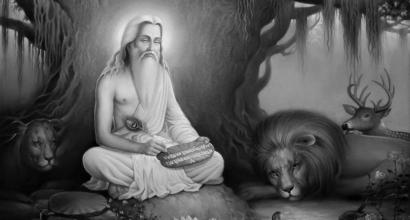
Conversation between Ātreyī and Vāsantī; (Lava and Kuśa grow up in Vālmīki maharṣi’s āśrama; they display expertise in using the jṛmbhakāstra; Lava and Kuśa undergo training; the Rāmāyaṇa is composed; Rāma pledges to have a golden image of Sītā beside him when he performs the aśvamedha; Lakṣmaṇa’s son Candraketu follows the horse; Rāma arrives at Janasthāna to kill Śaṃbūka) A divine being emerges out of Śaṃbūka and tells that the place is called Janasthāna; Rāma recollects that he had spent happy times in the company of Sītā there in the past and laments her absence. – Aṅka 2
Sītā, in order to celebrate the twelfth birthday of her sons, is in the company of Godāvarī, who had come from the pātāla-loka. Rāma lands at the same spot from his vimāna. Sītā is accompanied by Tamasā, and Rāma by Vāsantī; Sītā is invisible to everyone other than Tamasā; Vāsantī recollects the events of the past as well as the abandonment of Sītā, and these memories cause immense agony to Rāma; both Rāma and Sītā faint multiple times due to agony; Tamasā consoles Sītā; Sītā, who is still invisible to Rāma touches him to bring him back to consciousness; finally, Sītā heads towards Vālmīki maharṣi’s āśrama and Rāma towards Ayodhyā – Aṅka 3
A scene in Vālmīki maharṣi’s āśrama; Janaka, Vasiṣṭha, Kausalyā, and others arrive there from Ṛṣyaśṛṅga’s yajña; they had made up their minds that they would not return to Ayodhyā without Sītā; they speak to each other. They see Lava there and find him to bear a close resemblance to Sītā and Rāma; Janaka, Kausalyā, and others converse with him. Lava, upon learning that the aśvamedha horse had arrived at their āśrama, captures it. – Aṅka 4
Candraketu faces Lava in a battle. (Lava uses the jṛmbhakāstra to freeze his enemy). Lava recalls and ridicules Rāma’s acts, which enrages Candraketu; he fights Lava. – Aṅka 5
A conversation between a vidyādhara couple; (Lava and Candraketu fight each other; Rāma comes there and stands amidst them after having killed Śaṃbūka). Rāma and Lava develop affection for each other; upon Rāma’s request, Lava withdraws his jṛmbhakāstra. Kuśa returns from the āśrama of Bharata-muni; Rāma perceives resemblance to himself and Sītā in Lava and Kuśa; he listens to a few verses of the Rāmāyaṇa from the twin boys and laments for the events of the past. (In the meantime, Vasiṣṭha, Arundhatī, Janaka, Kausalyā and others who learn that the boys were fighting each other, rush to the spot. Rāma’s mothers are agonised upon seeing their son in the current state and faint.) Rāma tries to console them; the younger boys also accompany Rāma. – Aṅka 6
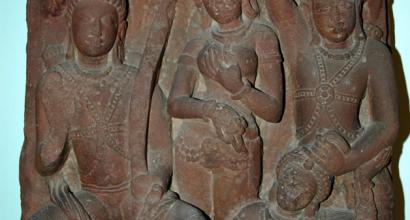
Vālmīki arranges for the enactment of the story of the Rāmāyaṇa, starting from the abandonment of Sītā by Rāma; the devas, asuras, humans, uragas, and the citizens of the kingdom assemble on the banks of the river Gaṅgā to watch the play; as a part of the play, the assembled people watch Sītā falling into the river Gaṅgā and being escorted to the pātāla-loka by Gaṅgā-devī and Bhū-devī. (Gaṅgā-devī and Bhū-devī leave Sītā under Arundhatī’s care) Arundhatī praises Sītā and offers her back to Rāma even as people are watching; Vālmīki unites the twins, Lava and Kuśa, with their parents. Śatrughna arrives there after having slain Lavaṇāsura; Ṛṣyaśṛṅga and Śāntā also join them. – Aṅka 7
Most scholars opine that the Uttara-kāṇḍa of the Rāmāyaṇa is a later-day addition; also, they say that there are many interpolations in its current form. however, it is likely that Bhavabhūti had access to the same version of the text as available to us today; nevertheless, it is hard to say if he has based his play Uttara-rāma-carita, on the Uttara-kāṇḍa or a on version of the story that was available to him in the oral tradition.
As per the Uttara-kāṇḍa, Sītā grew pregnant ten thousand years after Rāma’s coronation as the king of Ayodhyā; that is when she desires to visit ṛṣyāśramas; a short while after this, Rāma hears from Bhadra the kind of accusations his people were making about Sītā’s character; he immediately instructs Lakṣmaṇa to drop her off near Vālmīki’s āśrama and the younger brother obeys the elder; Sage Vālmīki who learns this, brings her to his āśrama and takes care of all her needs; Lava and Kuśa are born; Śatrughna, who is on his way to kill Lavaṇāsura happens to arrive at the āśrama the very night the twins were born. Twelve years after killing Lavaṇāsura, he passes through Vālmīki’s āśrama on his way to Ayodhyā, stays there for a week, and returns. Rāma slays Śambūka at Janasthāna; he then performs the aśvamedha with a golden image of Sītā in the Naimiśāraṇya; Sage Vālmīki arrives there with Lava and Kuśa and makes them sing the Rāmāyaṇa. Rāma learns about the boys and sends for Sītā, who was in Vālmīki’s āśrama; he asks her to establish her chastity by making the relevant vows; Sītā, on the other hand, decides to return to her mother – she prays to bhūmi-devī, who appears there to take her away.
To be continued ...
The current series of articles is an enlarged adaption of Prof. A. R. Krishnasastri's Kannada treatise Saṃskṛta-nāṭaka. They are presented along with additional information and footnotes by Arjun Bharadwaj.