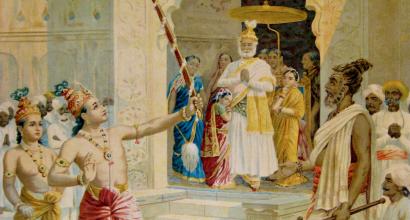

The story of Hariścandra is quite old, and it dates back to the Vedic times; as it won the hearts of the people at large, it gathered more substance with time; a few recensions of the Mahābhārata also contain the tale, and are likely to be an interpolation; the tale, nevertheless, appears to have grown to large proportions. We cannot deny that the version of the story that occurs in such recensions of the epic is filled with exaggerations and elements that border on anaucitya. It is unlikely that Kṣemīśvara had that tale as the basis of his play. The play does not narrate the episodes connected with the fight between Viśvāmitra and Vasiṣṭha, the story of the pariah woman, and the accusation that Candramatī killed the Kaśī king’s son. The poet has adapted the ideas of vidyādhidevatās, Vighneśvara, and Viśvedevatās to suit his plot. He has changed the purpose behind the demand of dakṣiṇa; while many versions of the story say that the dakṣiṇa was to be offered for the rāja-sūyayāga, Kṣemīśvara associates the dakṣiṇa with bhū-dāna. He has retained the episode where the king and the queen attempt to commit suicide in the crematorium and has added value to it by showcasing the magnanimity of Hariścandra’s and Śaibyā’s personalities. He has chosen to omit the part of the popular narrative where the king falls asleep in the crematorium and has an interesting dream. He has created the episode where the Kāpālika brings the nidhi with him and gains the vidyās. The associated events add another dimension to Hariścandra’s personality. In sum, we can say that Kṣemīśvara has displayed great skill in converting a purāṇic tale into a play.
The play begins with utpāta-śānti; through this, it is suggested that Hariścandra is going to suffer innumerable troubles, and Kauśika is merely going to be a nimitta-kāraṇa, i.e., a pretext. Bhṛṅgiriṭi, who was serving Bhagavān Śiva and Devī Pārvatī, is not devoid of troubles either – “pūrva-karma-paripākaṃ durvilaṅghyam,” after all! Throughout the play, it is suggested that fate cannot be transcended by humans. The upādhyāya, the caṇḍāla or someone else becomes the nimitta-kāraṇa for vidhi to turn favourable. However, to undergo the troubles that occur in the intermittent period is challenging for anyone to endure. Our devotion to the Divine naturally diminishes, and we lose faith in dharma; we are dejected. However, a dhīra – a mature and noble person will never forsake dharma; finally, two and two may add up to result in greater good. Such positive outcomes only reaffirm the statement “na hi kalyāṇakṛtkaścita durgatiṃ tāta! gacchati”. Readers who are not acquainted with the dhārmic tradition of Bhārata and the cultural undercurrents may not be able to appreciate the drama; they may not be able to relate to the layered suggestions in the play.
Thus, we can, in a sense, say that the play is based on dharma, and Hariścandra is an embodiment of honesty and righteousness. Nevertheless, the other characters in the play are not personifications of high values like we see in Prabodhacandrodaya. All the characters, places, and situations in the play are relatable even to this day – husband, wife, son, honesty, dharma, travails, death, are śmaśāna are relevant even today. These elements of the play have, perhaps, won the hearts of its readers. The poet has displayed good skill in portraying these aspects such that they directly relate to our real-life experiences. The segments connected with śṛṅgāra that occur at the beginning of the play are quite superfluous, like in the Nāgānanda and Veṇīsaṃhāra. We can justify their inclusion to some extent because they indicate the immense love Hariścandra had for his wife and was ready to sell such a lady to uphold dharma. The poet has included such segments connected with śṛṅgāra probably also because he wanted to sprinkle his play with rasas other than pathos as well; or perhaps, he wanted to cater to the tastes of his people, or he wished to adhere to the poetic tradition, which has the unwritten rule of including many rasas. Most of the play evokes karuṇa and vīra rasas. Hariścandra displays great amounts of vīra in the dhārmic dāna that he performs in the future. Nevertheless, we must admit that karuṇa rasa dominates over vīra in large parts of the play.
Who is the real nāyaka of the play? Is it Kauśika or Hariścandra? Kauśika permeates the entire story and also has his presence in the name of the play – he may appear to be the nāyaka. However, his narcissism, ego, and extreme anger make him a dhīroddhata; he possesses the qualities of a prati-nāyaka. Because Hariścandra ‘defeats’ him by his qualities of a dhīrodāta, he is the true nāyaka of the play; or perhaps, such was the poet’s intention.
The play has the features that most other plays of its time display. It is filled with numerous verses and contains excessive varṇanā. The descriptions of the wild boar, hunting, and crematorium are long and pedantic. The poet’s language is quite complex and is full of samāsas.
To be continued ...
The current series of articles is an enlarged adaption of Prof. A. R. Krishnasastri's Kannada treatise Saṃskṛta-nāṭaka. They are presented along with additional information and footnotes by Arjun Bharadwaj.