In an earlier episode, while discussing the revival of modern Kannada, we reminisced about Mysore’s GTA, the university graduates’ association. One among the main people driving the association was M L Shreekantesha Gowda. Soon after completing his B.A., B.L., he got a job in the government’s Judicial Department. For a few years, he was a munsif in Madhugiri. After his retirement he lived in Basavanagudi on the first floor of a house that he owned. The house was in a corner and faced the Maharashtra Girls School.
Author:Dhruva Somayaji
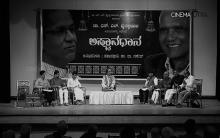
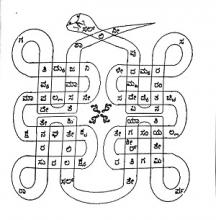
Avadhānam is an ancient art/sport of India. It involves extempore creation of metrical verses on a variety of topics under myriad aesthetic constraints. It is a quintessential representative of that defining trait of all Indian classical arts – spontaneity. “Cittaikāgryam avadhānam,” “Avadhānam is the focusing of the mind” is its traditional definition. Any exercise in any art form requiring extensive concentration can borrow this term.
Age of Glory
In the recent writings on Indian history, there are several episodes and events that have been given undue respect and importance. Several details that are not found in honest treatises of history have been presented to us and we are misguided and cheated; these also come in the way of our pursuit for the vision of truth. Almost all our history textbooks of today fall under this category of deceitful writing.
From what I’ve heard, Sri Vasudeva Sastri hailed from Doddaballapura. His Highness the Maharaja of Mysore bestowed upon him the title of “Vidyanidhi” (literally: Treasure of Knowledge). Perhaps he was the first in a line of scholars to receive the “Vidyanidhi” honorific. He also earned renown as “Jaganmithya” Vasudeva Sastri.
ARAṆYA-PARVA
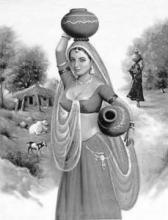
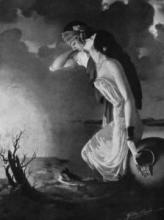
Here we see a fluttering of the left eye of a woman separated from her husband. For women, this is a good omen indeed! Anticipating the return of her husband, she ties a festoon with her eyes to the entrance door and tells the left eye, “O Left Eye, who signalled the good omen of my husband’s return! Out of gratitude for your help to me, I will first see my husband through you and will reward you in that manner.” Look here, we find a charitable rest-house; a place where weary travellers are offered water to quench their thirst. There’s a beautiful girl here who offers the water.
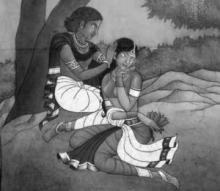
One has to really admire the cleverness of some of these two-timing women. One of them turned in a fine performance of bawling after having, apparently, been stung by a scorpion. Her friends, ever too eager to help, carried her away right in front of her artless husband – evidently to get her the much-needed medical assistance. No prizes here for guessing that it was in fact to her lover’s secret nest that she was really transported to. Now this next one has brought her lover to her home and has in fact introduced him to her husband as a kinsman from her hometown!
We shall now go back in time by nearly two thousand years. Behold! Godavari flows in a mellifluous melancholic tune. Swaying the entire countryside near Pratiṣṭhāna[1] to the graceful swinging of her waves, as she gushes on, yearning to rendezvous with her beloved, the Eastern Ocean. That is indeed why her valleys are dotted with dense reeds and canes – signifying the frequent haunts of passionate young lovers.