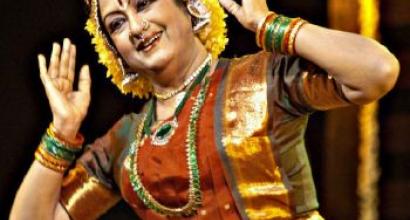
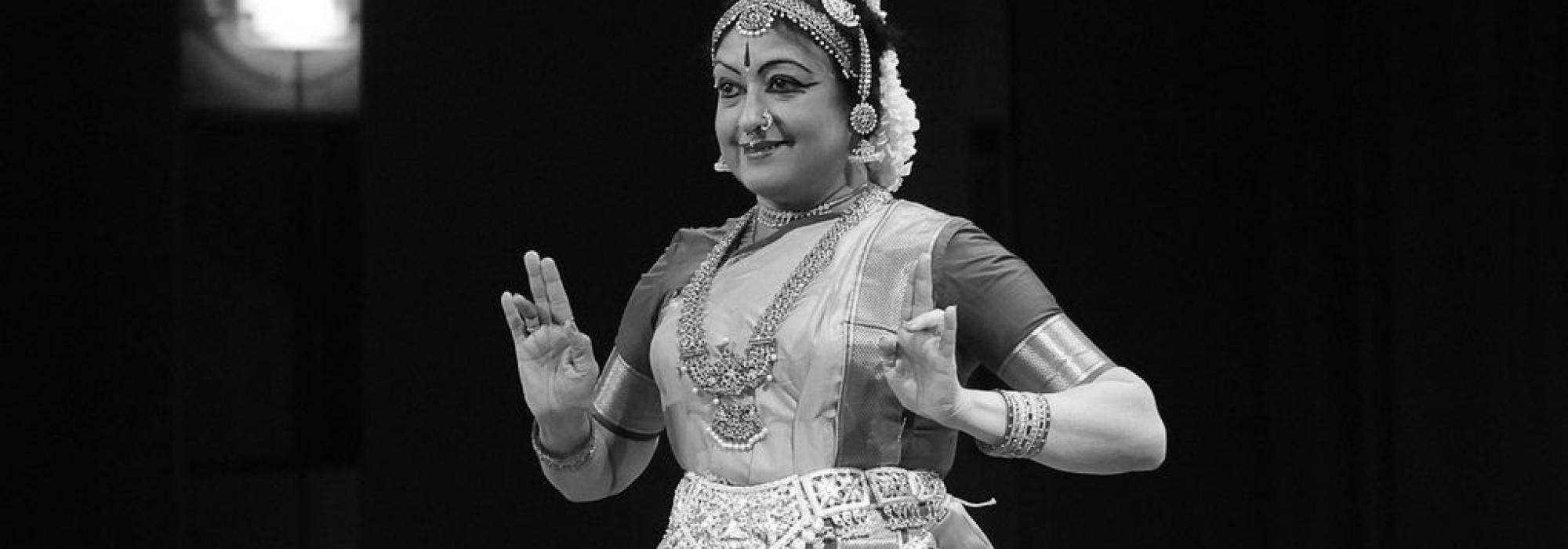
Padma is widely recognized for her path-breaking reconstruction of the mārga-karaṇas. Her achievements as a researcher and performer of this universal language are comparable only to the combined efforts of Bhagavān Pāṇini (as well as Maharṣi Patañjali) and Amarasiṃha, the masters of Sanskrit grammar and thesaurus respectively. At an early stage in life, she realized that the sublime scheme of Bharata accommodates all beautiful movements, regardless of the barriers of space and time. Here lies the greatness of her recognition (pratyabhijñāna) and reconstruction (punassandhāna) of karaṇas.
Amongst the most unique features of Padma’s art lies in her ability of flawless transmission of every thought, idea, and emotion. There is almost an advaita between her own mind and body – her body appears to be a concrete manifestation of her mind. While many of us struggle to capture our thoughts through words and action, Padma stands as a towering example of an artist who has trained her body so extensively that it communicates everything she wishes to. She, in fact, is a living example of her redefinition of karaṇa – ātma-kāya-samāyogaḥ nṛttasya karaṇaṃ bhavet. We can invariably see her brilliant creative thoughts, illuminated by her ātma-prakāśa flowing out through her body.
One can confidently say that Dr. Padma Subrahmanyam is the Kālidāsa of Indian dance.[1] This analogy is not exaggerated at any rate, for it is strikingly meaningful. In Kālidāsa we realise in a beautiful and precise manner the values of life as revealed in nature and culture. In the words of Dr. V Raghavan, “Kālidāsa represents the quintessence of Indian culture and heritage, and whether it is a native who wants to partake of it or an outsider who seeks an authentic messiah of it, to both of them, Kālidāsa is the most satisfactory and at the same time the most attractive exponent of it.” Padma Subrahmanyam falls no short of this estimation, for her art is nothing but the visual manifestation of the great poet’s vision. To visualize Kālidāsa, one must watch Padma’s dance and to read Padma, one must surrender to Kālidāsa. Such is the heights of creativity and erudition of the two stalwarts.
~
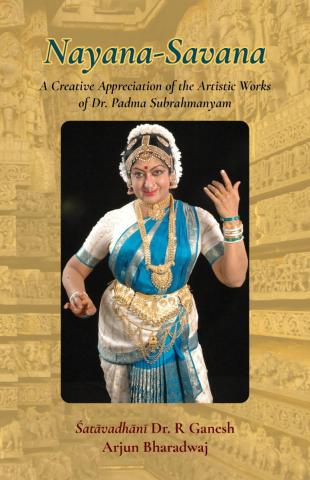
The current work is a humble attempt of the authors in the creative appreciation of the solo presentations of the peerless artist Dr. Padma Subrahmanyam. Indian aestheticians have always recognised dhvani as sahṛdaya-gocara – suggestion in art resonates in the heart of the connoisseur as per his own saṃskāra. Moreover, a great work of art of an erudite and conscious artist, who is endowed with impeccable pratibhā, at times, may reveal several layers of meaning to a connoisseur, even when the artist has not deliberately intended to bring them all.[2] The spontaneous inspiration with which an artist creates her art transcends her usual physical and emotional limitations and therefore, makes a spiritual connect with the conscious connoisseur. In this background, the reader will need to note that essays in the current work have been penned by the authors within their own limitations. Just as the works of Kālidāsa reveal fresh layers of suggestion upon every read and enraptures the sahṛdaya, Padma’s art too has the potential of triggering multiple dimensions of meaning upon each viewing. The readers are welcome to verify interpretations presented in the current work by viewing the available videos.
Dr. Padma Subrahmanyam is known to have created many full-fledged master pieces in the genre of bhāṇikā and innumerable short-length choreographies.[3] In the current work, six such bhāṇikās have been discussed in detail and the salient features of two others have been provided. Additionally, creative analysis of about sixteen independent pieces have been documented. We are convinced that the fundamental governing principles of Padma’s art are adequately captured through these. Additionally, we have included a separate chapter on the tele-serial Bhāratīya-nāṭyaśāstra, which attempts to examine the creative elements in the exceptional documentary. Upon going through all the articles, we hope that the reader will be able to get a fair sense of the nature of Padma’s approach towards art and her creative genius; with this background, connoisseurs will be able to understand and appreciate every work of Dr. Padma Subrahmanyam.
It is needless to say that Padma’s undaunted spirit, rich life experiences, tremendous learning in various domains, as well as the guidance of several spiritual masters have contributed in shaping her works of art and have sculpted her personality. In the current work, however, we have not delved into the personal experiences of the artist which would have aided in her creation of splendid works of art. All productions and choreographies have been analysed only through objective, eternal, and universal principle of aesthetics; when the context requires, we have attempted to point out the various tangible cross-currents of knowledge, learning, intuition, and talent that have worked together in the shaping and presentation of a specific idea. We hope that our approach helps the reader and the connoisseur in understanding the universality of Padma’s art, which transcends all spatio-temporal parameters which would have aided in its creation.
To be continued
The current article is an extract from the book Nayana-Savana, authored by Shatavadhani Dr R. Ganesh and Arjun Bharadwaj.
[2] This brings to mind the words of Ānanda-vardhana. He says – alaṅkārāntarāṇi
hi nirūpyamāṇa-durghaṭanānyapi rasa-samāhita-cetasaḥ pratibhānavataḥ kaveraham-pūrvikayā parāpatanti | (Dhvanyāloka, Udyota 2, prose segment after verse 15)
Through the above words, Ānanda-vardhana captures the fact that even when a creative artist, who is solely devoted to Rasa deliberately knits together ideas, even the alaṅkāras which would have appeared impossible to incorporate rush to her effortlessly.
This is akin to Svāmī Vidyāraṇya’s words in the treatise Dṛk-dṛśya-viveka
dehābhimāne galite vijñāte paramātmani|
yatra yatra mano yāti tatra tatra samādhayaḥ||
Once a spiritual seeker has overcome attachments to his body and has realised the Paramātmā, the mind experiences Brahma-samādhi, wherever it goes.
Similarly, every artistic utterance and gesture of Dr. Padma Subrahmanyam, who has realised Rasa and Dharma, naturally comes with immense suggestion and sublimity.
[3] Dr. Padma Subrahmanyam is known to have choreographed and performed many more Bhāṇikās and short-length pieces, totalling to over two hundred unique productions. These include full-fledged presentations on Kamba-rāmāyaṇam, Tiruppāvai as well the compositions of Tiruvaḷḷuvār, Nāyanmārs, Ūtthukāḍu Veṅkaṭa-kavi, and Female poets (Strī-kavi-ratna). However, video recordings of many of these are not available. One can only wonder the brilliant nuances and subtle interpretations that the maestro would have brought in such choreographies. We look forward to watching these performances live. It appears that only about ten percent of her unique productions have been documented.
Additionally, Padma invariably brings in newer interpretations each time she presents a choreography. In the essays in the current work, we have tried to document as many beautiful instances as possible.